How Children Learn to Sort by More Than One Rule
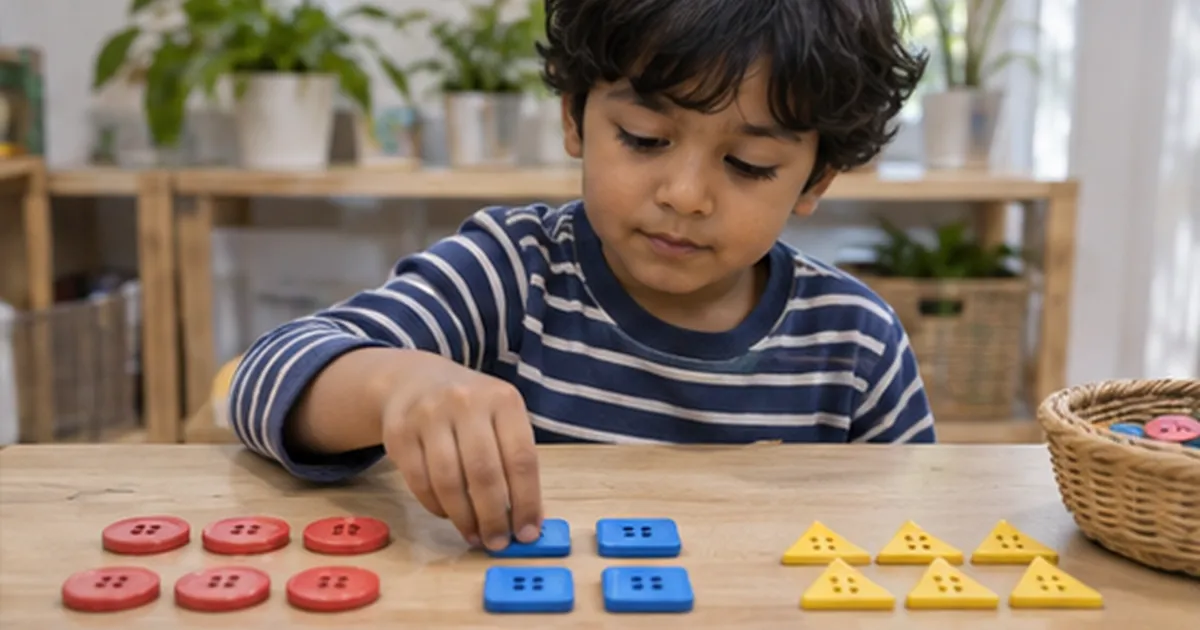
Introduction to the concept of sorting by more than one rule is a fundamental aspect of cognitive development in children. This process involves understanding how children learn to categorize objects based on multiple characteristics, such as shape, color, and size. To illustrate this concept, let's consider a fictional example of a child named Emma, who is presented with a card sorting task designed to reflect common developmental challenges in early childhood.
Change the rule while keeping the buttons
Place a red square button, a blue square button, and a red round button on the table. Under the color rule, the two red buttons belong together. Under the shape rule, the red square moves beside the blue square. Ask the learner to explain the switch. A correct grouping could reflect a lucky choice, imitation, or a remembered rule. Changing the position of the buttons and introducing a new square gives the observer a better way to distinguish those explanations. Keep the labels consistent while testing the new rule.
Card Sorting Task
Emma is given a set of cards with different shapes, colors, and sizes, and is asked to sort them into categories. Initially, she is instructed to sort the cards by shape, and she successfully groups all the cards with the same shape together. When the instructions change to sorting by color, Emma has difficulty shifting from the previous rule. This fictional example illustrates a common challenge children may face when learning to switch between sorting rules, reflecting typical cognitive flexibility development in early childhood.
Changing Instructions
When the instructions change, Emma must adapt her sorting strategy to accommodate the new rule. This requires holding multiple rules in mind and shifting attention between them—a process supported by developing executive function skills, particularly cognitive flexibility and working memory. Children often find it difficult to inhibit a previously relevant rule when a new one is introduced, which can lead to errors. This pattern is commonly observed in developmental psychology research, such as in tasks similar to the Dimensional Change Card Sort (DCCS), though individual differences in performance are common.
Memory and Competing Explanations
Emma's ability to sort the cards by more than one rule is influenced by her working memory and capacity to manage conflicting rules. As she sorts, she must recall the current rule, suppress the previous one, and resolve any mismatches when attributes conflict—such as a red circle among blue circles. These demands reflect the cognitive load involved in rule-switching tasks. Problem-solving in such contexts depends on developing executive functions, not on 'competing explanations' in a scientific sense, which is a mischaracterization of the cognitive process.
Age Bands and Developmental Patterns
Age bands describe broad patterns of cognitive development, but they do not represent deadlines or universal sequences. Children develop at different rates, and their ability to sort by more than one rule is influenced by a range of factors, including social, physical, and cognitive changes. For example, a child who has had more experience with sorting tasks may develop this skill earlier than a child with less experience. However, this does not mean that the child with less experience is inherently less capable, but rather that they may need more practice and instruction to master the skill.
- Social changes, such as interacting with peers and adults, can influence a child's ability to sort by more than one rule.
- Physical changes, such as improvements in fine motor skills, can also impact a child's ability to sort cards and other objects.
- Cognitive changes, such as developments in working memory and problem-solving skills, are critical for learning to sort by more than one rule.
Contrasting Case: Sorting by Multiple Attributes
To illustrate the complexities of sorting by more than one rule, consider a fictional scenario where Emma is asked to sort cards using two attributes simultaneously—such as both shape and color. For example, she might be instructed to group all red circles together, separate from blue circles or red squares. This task requires integrating multiple rules at once, which places greater demands on working memory and cognitive control. Successfully managing such a task typically emerges gradually during early childhood and reflects advances in executive function.
- Emma must first identify the relevant attributes, such as shape and color, and understand how they relate to each other.
- She must then apply the rules for each attribute, such as sorting by shape and then by color, or vice versa.
- Conflicts may arise when a card’s attributes don’t align with a combined rule—for instance, a red circle in a group defined by blue shapes. Emma must then rely on task instructions to determine which attributes define the category. Resolving such mismatches depends on attention to current rules rather than on reconciling 'contradictions' in a logical sense.
In this contrasting case, Emma's ability to sort by multiple attributes is influenced by her working memory, problem-solving skills, and ability to inhibit previous rules and apply new ones. The task requires her to think flexibly and adapt to changing instructions, which is a critical aspect of cognitive development.
Lesson Learned
The example of Emma sorting cards by more than one rule illustrates the complexities of cognitive development in children. The ability to sort by multiple rules is influenced by a range of factors, including working memory, problem-solving skills, and social, physical, and cognitive changes. By understanding how children learn to sort by more than one rule, we can gain insights into the developmental patterns that underlie this skill, and how to support children as they develop this critical aspect of cognitive ability.
The lesson learned from Emma's example is that sorting by more than one rule is a complex task that requires children to hold multiple rules in their working memory, switch between them, and reconcile conflicts. This task is influenced by a range of factors, including social, physical, and cognitive changes, and requires children to think flexibly and adapt to changing instructions. By understanding the complexities of sorting by more than one rule, we can better support children as they develop this critical aspect of cognitive ability, and provide them with the instruction and practice they need to master this skill.
In conclusion, the ability to sort by more than one rule is a fundamental aspect of cognitive development in children. This process involves understanding how children learn to categorize objects based on multiple characteristics, and how they adapt to changing instructions and reconcile conflicts. By examining the example of Emma sorting cards by more than one rule, we can gain insights into the developmental patterns that underlie this skill, and how to support children as they develop this critical aspect of cognitive ability. It is essential to recognize that age bands describe broad patterns, not deadlines or universal sequences, and that social, physical, and cognitive changes need separate evidence. By understanding the complexities of sorting by more than one rule, we can provide children with the instruction and practice they need to master this skill, and support their overall cognitive development.
Max is a fictional child in another illustrative example. He is initially instructed to sort toys by shape and correctly groups blocks, dolls, cars, and balls. When asked to sort by color instead, he initially continues using the shape rule, showing difficulty shifting strategies—a common observation in young children. This example is not based on a real child but is intended to reflect typical developmental patterns in cognitive flexibility.
Worked Solution
For example, Max may learn to sort toys hierarchically—first by shape, then by color within each shape group. This layered approach reflects increasingly complex cognitive organization and is supported by maturing executive functions. The ability to apply multiple rules in sequence develops gradually and varies across children depending on experience and cognitive growth.
- Max starts by sorting the toys into categories based on shape, such as blocks, dolls, cars, and balls.
- He then sorts each category further based on color, such as sorting the blocks into red, blue, and green categories.
- Max must reconcile any conflicts that arise when the rules for each attribute contradict each other, such as when a toy has a shape that is associated with one color but is actually a different color.
Changing Conditions
- If a new attribute such as texture is introduced, Max would need to consider shape, color, size, and texture together. This increases the cognitive load and requires more advanced integration of rules. Fictionally, this scenario demonstrates how adding dimensions to a sorting task challenges children’s working memory and rule-monitoring abilities, which are still developing in early childhood.
- He would need to apply rules sequentially or in combination—such as sorting by shape first, then by color, then by size, and finally by texture. The order and success of such sorting depend on task clarity, cognitive capacity, and prior experience. This fictional progression illustrates how increasing task complexity can reveal aspects of cognitive development, particularly in executive function.
- Max would need to reconcile any conflicts that arise when the rules for each attribute contradict each other, which would require him to think even more flexibly and adapt to changing instructions.
By changing one condition of the task, we can observe how Max's sorting strategy changes and how he adapts to the new instructions. This would provide valuable insights into his cognitive development and his ability to sort by multiple rules.
For the wider context, read Roovet’s guide to developmental psychology across the lifespan or explore the developmental psychology course.