How Cohort Effects Can Look Like Age Differences
A cohort effect is a difference associated with belonging to a group that encountered particular historical conditions at a similar time in life. It can look like an age effect when a researcher compares younger and older people only once. If older adults outperform younger adults on a paper map task today, they might have had more years navigating with printed maps. The comparison alone cannot tell us how any individual’s map skill changed as that person grew older.
The map that makes one group look better
Imagine a fictional class project at a community learning center. Students invite two groups of volunteers to find a route between a library and a park on a printed street map. One group consists of younger adults and the other of older adults. Everyone receives the same map, sits in the same room, and gets the same instructions. The class records how long it takes each person to trace a valid route.
The older group has a shorter average completion time. A student writes, “Map reading improves with age.” The sentence silently changes the question. The class observed a difference between groups. The sentence describes a change within people. Nobody in the project observed one person at two different ages. That missing comparison matters even if the stopwatch was accurate and the average was calculated correctly.
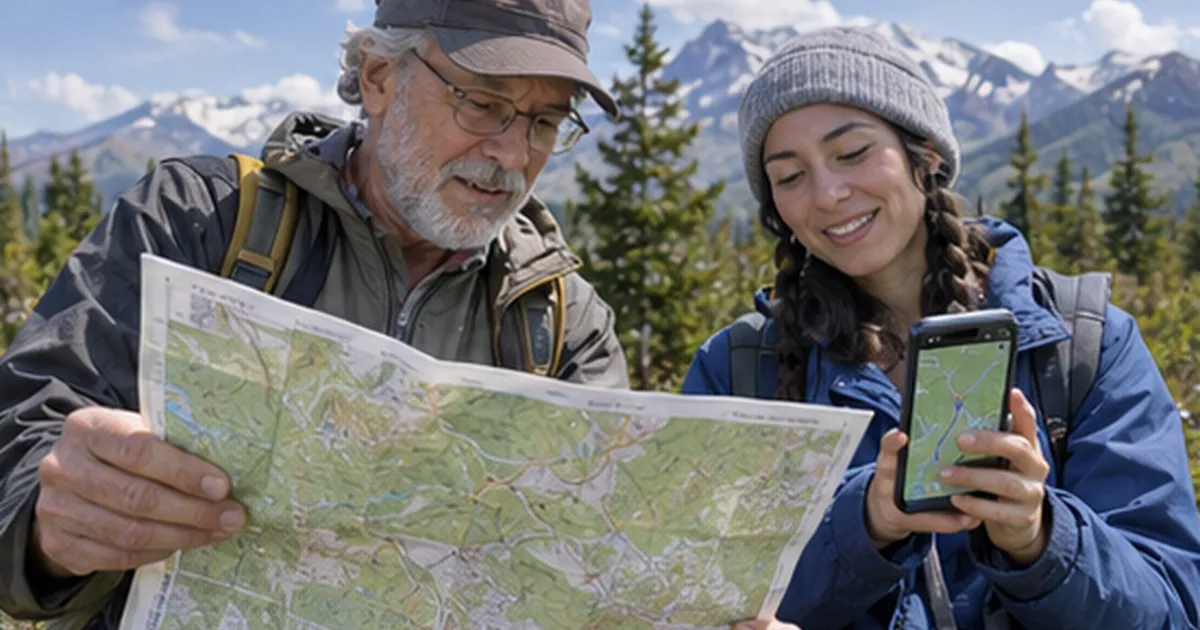
Ask what the task resembles. Reading a grid reference, finding the north arrow, and estimating a distance from a printed scale were everyday navigation activities for some participants. Others learned to navigate by entering a destination, following a spoken direction, and checking a small screen at each turn. Both groups may navigate effectively. The class selected a format that makes one history of practice particularly visible.
Age, period, and cohort answer different questions
An age-related explanation concerns something associated with a person's age or development. A period explanation concerns conditions at the time of observation. A cohort explanation concerns experiences shared by people whose lives intersected with particular historical conditions. The spread of phone navigation, for instance, could affect many people during the same calendar period. People who encountered it when first learning to drive may have formed different habits from those who encountered it after years of using printed maps.
This is more than a vocabulary exercise. Compare a person aged 25 in 2025 with a person aged 65 that same year. Their ages differ, and their birth years differ by the same amount. Compare two people aged 25, one assessed in 1985 and another in 2025. Now age is held constant, but both period and birth cohort differ. Researchers can choose informative comparisons, yet the mathematical relationship among age, period, and birth year limits what the data can identify without additional assumptions.
There is another reason to be cautious. A birth-year group is a rough marker of opportunity. It does not tell us which navigation tools a particular participant actually used. A younger volunteer may spend weekends orienteering with printed maps; an older volunteer may have used turn-by-turn navigation for years. Asking about relevant experience gives the class a better variable than a generational nickname.
Change one part of the classroom study
Suppose each volunteer completes two tasks. In one, the person plans a route on paper. In another, the person uses a navigation app to identify a route that avoids a closed street. Half the volunteers try paper first and half try the app first. The order matters because the first task may teach someone where the park is. Use comparable routes or record enough information to distinguish format from familiarity with a particular route.
Imagine that the older group is faster on paper while the younger group is faster on the app. That result weakens the broad claim that one age group is simply better at navigation. It suggests that the format matters. It still does not prove that practice history caused the difference. Screen size, contrast, prior familiarity with a particular app, and willingness to explore unfamiliar controls could also influence the results.
Collect one additional observation that discriminates between explanations. Before the task, ask how often each participant has used each format during the last year. Afterward, ask what strategy they used, then compare that description with the route they traced. If frequent paper users in both age groups tend to use the map key effectively, the experience explanation becomes more plausible. It remains an observational comparison. People who enjoy paper maps might choose to practice them precisely because they already find them easy.
Follow people over time, with a second question in mind
A longitudinal design could invite the same participants back a year later. Now the class can measure within-person change on a defined task. If an individual gets faster, the statement “this participant completed the follow-up task more quickly” is warranted. To explain the change, ask what happened between visits. The person may have practiced, remembered the first task, started a job involving navigation, or used a revised app with clearer controls.
Following one cohort also ties aging to the passage of calendar time. Everyone is a year older at the second visit, and everyone has lived through that particular year. Following several entry cohorts over overlapping intervals gives researchers more comparisons. They might examine people of similar ages tested at different times or compare the direction of change within different cohorts. The design improves the evidence, but it does not automatically eliminate every period effect or make the groups equivalent.
Who comes back is part of the result. People who struggled with the original task may be less inclined to return. A faster follow-up average could partly reflect a different set of participants. Report the number invited back, the number who returned, and whether the analysis compares the same people. A careful design can lose much of its advantage if the final summary quietly switches from individual change to unrelated group averages.
Try the reasoning on a different example
A workplace trainer notices that younger employees finish a new scheduling exercise sooner. The exercise uses shortcuts borrowed from popular phone apps. One explanation is that younger employees learn new procedures more quickly. Another is that some participants recognize the interface conventions. A third is that the older group includes more supervisors who pause to check the consequences of a scheduling change before submitting it.
The trainer can improve the question. Give all participants a short orientation to the controls, include a second task with a different interface, and record both accuracy and time. Ask participants which related systems they have used and whether they are responsible for approving schedules. If the speed gap shrinks after a short orientation while accuracy remains similar, familiarity becomes a stronger candidate. The data still do not justify a general claim about an age group's ability to learn.
Write a conclusion the design can support
For the original map project, a defensible sentence is: “In this volunteer sample, the older group traced the paper route faster on average under the conditions we used.” Add what would help explain it: “We would next compare paper and digital tasks and measure each participant’s prior experience with both.” The first sentence respects the data; the second turns uncertainty into a research decision.
When you encounter an age comparison, look for three details before accepting its explanation. Who was compared? When were they observed? What opportunities did the task assume? A study may tell you something important about different groups living at the same time. To claim that getting older changed a particular skill, the researcher must also account for the different histories those groups brought into the room.
For the wider context, read Roovet’s guide to developmental psychology across the lifespan or explore the developmental psychology course.