How Much Hands-On Help Does Online Primary School Take?
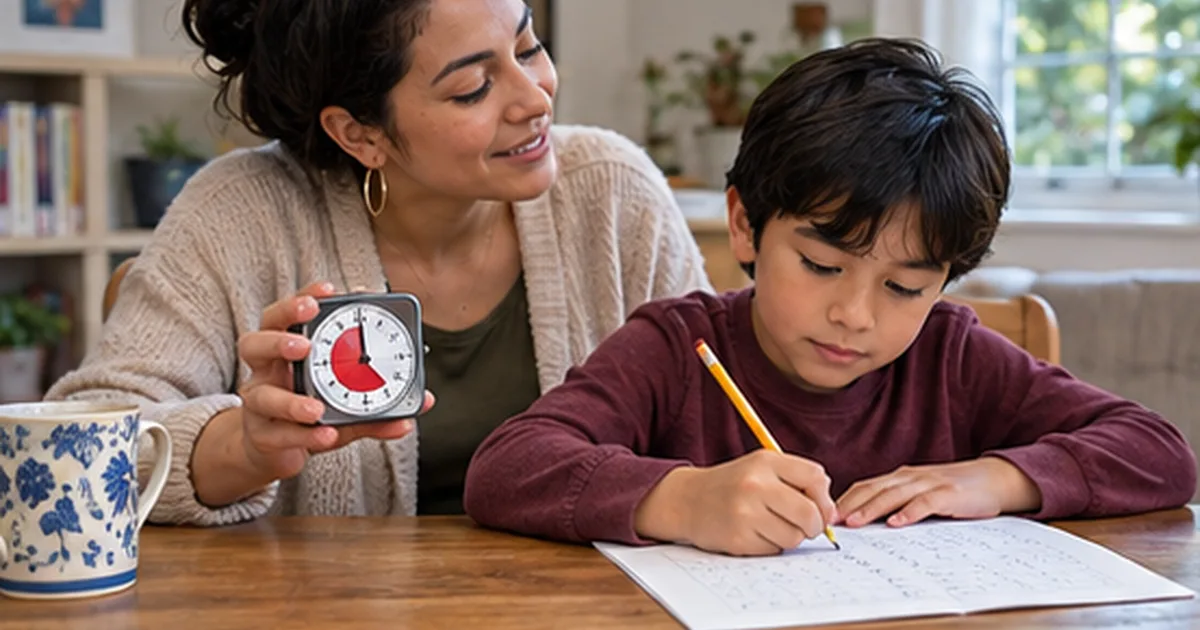
During one morning lesson, keep a tally of the times a child calls for help. Mark whether they need help with the subject, the device, or the next step in the routine. Those are different demands on an adult. The pattern can help a family decide where to sit alongside a child and where to give them a chance to work alone.
First Grade: Structured Guidance Every Step
For a typical 6-year-old like Maya Chen, a first-grade morning in an online primary school begins at 8:15 a.m. with a 10-minute video lesson on phonics. Maya’s mother, Lisa, starts by logging her into the learning platform. Maya can navigate basic menus but still confuses similar-looking icons. Lisa stays nearby, ready to clarify instructions.
The lesson asks Maya to identify short vowel sounds in CVC (consonant-vowel-consonant) words. After the video, she must complete an interactive worksheet matching words like "cat," "sit," and "run" to corresponding images. Maya misreads "run" as "ron" and selects the wrong picture. Lisa gently corrects her, modeling the sound: "Listen—/r/ /u/ /n/. What word does that make?"
This 20-minute task takes 35 minutes with redirection and small distractions—fiddling with pencils, asking for a snack. Lisa spends about 70% of the time actively guiding. She also records attendance and uploads a photo of the completed worksheet to the family’s private portfolio, as required by their state’s homeschool guidelines. At this stage, the parent functions as co-teacher, tech assistant, and behavior coach.
Math Practice with Tangible Tools
Next is a 15-minute math session on adding within 10. The platform displays number sentences like "4 + 3 = ?" Maya struggles to compute mentally. Lisa provides unifix cubes, guiding her to build a tower of four, then add three more, and count the total. This hands-on support turns abstract symbols into physical understanding.
When Maya enters "6" instead of "7" in the answer field, the system prompts her to try again. Lisa refrains from giving the answer but asks, "Can you show me with the cubes?" This encourages self-correction. The entire math block lasts 25 minutes, with Lisa intervening at least five times to redirect focus or clarify a step.
Third Grade: Shifting Toward Independence
By third grade, students like 8-year-old Javier Morales handle more tasks independently. His morning starts at 8:00 a.m. with a reading comprehension module on habitats. Javier logs in himself and navigates to the day’s assignment. He still needs reminders to stay on task—after five minutes, he switches tabs to a drawing app. His father, Carlos, notices and says, "I see you’re on the drawing tool. Let’s finish reading first, then you can sketch a rainforest animal later."
Javier reads a 300-word passage about coral reefs and answers multiple-choice questions. He gets tripped up by a question asking him to infer why coral bleaching affects fish populations. Carlos doesn’t supply the answer but asks, "What does the passage say about algae and coral?" This prompts Javier to reread and connect ideas. The intervention lasts under a minute, but it’s critical for building reasoning skills.
For math, Javier works on two-digit addition with regrouping. He correctly solves "37 + 48" on paper but enters "75" instead of "85" online. The system flags the error. Javier checks his work, finds the mistake, and corrects it. Here, the parent’s role is minimal—just verifying that Javier reviewed his steps. Over the course of the morning, Carlos spends about 15 minutes in direct support, mostly at transitions.
Writing with Scaffolding, Not Rewriting
Javier’s language arts assignment is a five-sentence paragraph about his favorite ecosystem. He drafts: "The rainforest is cool. It has monkeys. They eat fruit. It is wet. I like it." Carlos reviews it and asks, "Can you add a detail about the trees or the weather?" He doesn’t rewrite it but encourages expansion. Javier revises: "The rainforest is tall and wet. Monkeys live in the trees and eat fruit." This interaction models editing without taking over.
Parents at this level focus on fostering ownership. The goal isn’t perfection but progress in structure and detail. Javier saves his work to his digital folder—a step he now handles without help.
Fifth Grade: Supervision, Not Instruction
For 10-year-old Amina Patel, online primary school mornings are largely self-managed. She starts at 7:45 a.m., reviewing her task list without prompting. Her science module covers the water cycle. The lesson includes a short video, a diagram labeling activity, and a reflection question: "How does evaporation impact weather patterns?"
Amina completes the video and diagram independently. On the reflection question, she writes, "Evaporation puts water in the air. That can make clouds." Her mother, Neha, scans the response and suggests, "Can you connect that to rain or storms?" Amina revises: "When water evaporates, it forms clouds. Those clouds can cause rain or storms later." Neha’s input takes 45 seconds.
Long Division and Problem-Solving Habits
In math, Amina tackles long division: "156 ÷ 6." She sets it up correctly and works through the steps. She misplaces the quotient digit, writing 19 instead of 26. The platform provides immediate feedback: "Check your multiplication step." Amina reviews: "6 times 9 is 54, not 56." She recalculates and arrives at 26.
Here, the system’s feedback loop reduces the need for adult intervention. Neha only ensures Amina reviews errors independently. Over the entire morning block (7:45–9:15 a.m.), Neha spends about eight minutes in direct support—mostly checking in, not instructing.
Patterns Across Grades: Time and Task Type
A comparative look at time logs reveals how parental involvement shifts:
- First grade: 60–75 minutes of parent time per morning session, with frequent direct teaching and tech assistance.
- Third grade: 25–35 minutes, mostly for redirection and light feedback.
- Fifth grade: 10–15 minutes, primarily for progress checks and occasional clarification.
The type of support also evolves. Early grades demand modeling and step-by-step guidance. Upper elementary calls for fostering problem-solving habits and self-review. By fifth grade, many students manage time and navigation with minimal oversight.
Factors That Influence Daily Support Needs
Not all children progress at the same rate. Several factors affect how much hands-on help is needed on any given day:
- Learning differences: A child with dyslexia may need audiobooks or extra time on reading tasks, increasing parent involvement even in later grades.
- Platform design: Intuitive interfaces reduce login issues and navigation errors, decreasing the need for tech help.
- Family routines: A consistent morning schedule with defined workspaces improves focus and reduces interruptions.
- Subject matter: New topics, like fractions or grammar concepts, often require more initial support regardless of grade.
For example, when Maya learned subtraction with borrowing in second grade, Lisa spent two weeks providing daily support, using base-ten blocks and guided practice. Once Maya mastered the concept, time on task dropped sharply.
Building Independence: Practical Strategies
Parents can actively reduce hands-on involvement by teaching routines early. One approach is the "I do, we do, you do" model:
- Week 1: Parent logs in, reads instructions aloud, and guides each step.
- Week 3: Child logs in with parent nearby; parent only steps in if asked.
- Week 6: Child completes tasks independently; parent reviews work afterward.
Visual checklists help younger learners stay on track. A laminated chart with icons for "Log in," "Watch video," "Do activity," and "Save work" allows children to monitor progress without constant verbal prompts.
Another strategy is scheduled feedback times. Instead of hovering, parents set specific check-in points—e.g., after the first task and before lunch. This encourages self-direction while maintaining accountability.
When to Step In—and When to Hold Back
Knowing when to intervene is as important as knowing how. Parents should step in when:
- The child is repeatedly making the same error.
- There’s frustration that halts progress.
- A technical issue blocks access to content.
But it’s equally important to allow productive struggle. If a child pauses to think or tries a wrong answer before correcting it, that’s cognitive work—not a failure requiring rescue. For instance, when Javier hesitated on a word problem involving equal groups, Carlos waited 90 seconds before asking, "What are they asking you to find?" The pause allowed Javier to formulate his own strategy.
Parents can use a simple decision tree:
- Is the child off-task or confused?
- If off-task, redirect with a neutral prompt ("What’s next on your list?").
- If confused, ask a guiding question, not the answer.
- If still stuck after two minutes, offer a small hint.
Planning for the Long Term
Families considering online primary school should anticipate high initial time demands that taper over time. A realistic plan includes:
- Dedicating 1–1.5 hours daily for grades K–2.
- Reducing to 45 minutes in grades 3–4.
- Transitioning to 20–30 minutes of oversight by grade 5.
Some families integrate learning into broader routines—doing math while cooking or discussing science during walks. These moments don’t replace structured lessons but reinforce concepts with less direct pressure.
For those seeking structured curricula and tools to support independent learning, Roovet Academy offers resources designed to grow with the student. While no program eliminates the need for parental engagement, thoughtful design can reduce friction and help children take ownership of their education.
Explore Roovet Academy’s homeschool program.