Measuring Growth Without Confusing It With Performance
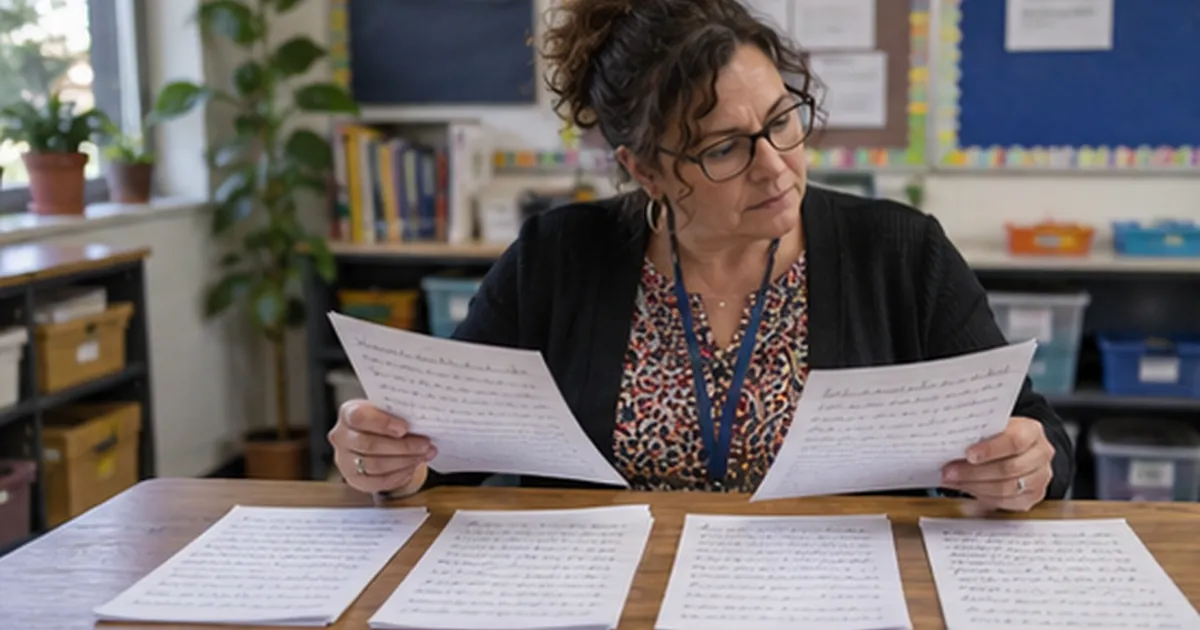
A better performance today is an observation. Growth is a claim about change that persists or appears across relevant situations. To move from the first statement to the second, compare more than one attempt, keep track of the conditions, and check what happens on an unfamiliar task after a delay. Handwriting offers a concrete example because the work can be saved, dated, and compared without relying entirely on memory.
Decide what “better” means before comparing samples
Imagine a teacher gathering writing samples from a fictional learner named Robin. The teacher initially writes, “Robin’s handwriting looks much better this month.” That sentence could refer to letter formation, spacing, alignment, speed, consistency, or the teacher’s ability to read the sentence without guessing. Those outcomes can change in different directions. A carefully copied line might be easy to read while taking much longer than ordinary classwork.
Choose one question that matters to the learner. Suppose Robin wants classmates to be able to read short messages without asking where one word ends and the next begins. The teacher and Robin agree to look at word spacing. They can also note how long the task takes, but they will keep that information separate. Now an improvement in decorative letter shapes will not be mistaken for an improvement in the feature they decided to study.
Use a visible rule for scoring. For each boundary between words, a reader marks whether they can distinguish the separation without using the meaning of the sentence to guess. Try the rule on several old examples before relying on it. If two readers disagree frequently, discuss which examples caused the problem. A practice score is useful only insofar as its meaning remains sufficiently consistent from one observation to the next.
Record the conditions of the first attempt
On Monday, Robin copies a seven-word sentence from a card. A seven-word sentence has six boundaries between adjacent words. The teacher can clearly identify three of the six. Write down the date, the task, the tool, and the kind of help Robin received. If an adult pointed out where to leave a space, include that detail. It changes what the sample can establish about independent work.
Keep a second sample from an ordinary lesson, such as a short answer about a story. That answer may contain different words and a different number of boundaries. The two samples serve different purposes. The copied sentence is easier to reproduce under similar conditions. The short answer shows what happens while Robin is also composing a thought. Differences between them are worth understanding and should not be averaged away automatically.
Ask what changed besides the learner
On Friday, Robin copies the same seven-word sentence and five of its six boundaries are clear. The observed count has risen from three to five. The teacher can say exactly that. Before calling it growth, check whether Robin used a wider pencil, had more time, copied from a larger model, or remembered where the teacher had paused on Monday. Each possibility suggests a different follow-up.
A change in conditions does not make the Friday sample worthless. Suppose a wider pencil helps Robin produce clearer spacing with less effort. The teacher has learned something useful about the working arrangement. It is simply a different finding from learning that the spacing skill now appears whichever tool Robin uses. A classroom decision about which pencil to offer may be warranted before a general statement about development is warranted.
Practice with the same sentence deserves similar care. Learning a familiar sequence is real learning, but it may be narrow. Robin could remember that a particularly long gap belongs after a particular word. If the goal is to leave readable spaces while writing any message, look for a new sentence that gives Robin a fair chance to use the same idea without copying the remembered pattern.
Plan a transfer check and a delayed check
Prepare a new sentence of comparable length, using familiar words and similar writing materials. Avoid changing every feature at once. If the second sentence contains unfamiliar spelling and Robin struggles, the teacher will have difficulty separating the demands of spelling from the demands of spacing. Record whether a prompt was offered and let Robin write under conditions similar to those used for the original comparison.
Then return to a fresh sample a few days later. An immediate improvement after feedback tells the teacher that the feedback helped on that occasion. A successful later attempt without the reminder provides stronger evidence that the learner can use the idea independently. One unsuccessful later attempt is also informative. Look at what was different about the task and whether the difficulty recurs before concluding that the learning disappeared.
Suppose Robin shows five clear boundaries out of six on a new copied sentence but only two out of five on a self-composed message. That pattern points to a next teaching decision. The spacing method appears available during copying, while composing a message introduces additional demands. Try a brief pause between planning the message and writing it. Observe whether that adjustment helps Robin attend to the spacing while preserving the meaning they want to communicate.
Distinguish score changes from meaningful changes
Percentages can make a small sample sound more precise than it is. Three clear boundaries out of six is 50 percent; five out of six is about 83 percent. Yet the difference is two boundaries on one short line. Keep the counts next to the percentages and look at the actual writing. One improvement might occur at the very place where a classmate previously misread a message. Another might happen on an already understandable phrase. The practical importance comes from the reading task, not from the percentage alone.
Ask Robin to interpret the work too. Which change was deliberate? Which part was difficult to maintain? A learner’s explanation provides information about strategy that a finished page may conceal. It is one source of evidence alongside the work samples. If Robin reports using the spacing plan but the reader still cannot identify the boundaries, examine whether the plan needs refinement or whether the reader's scoring rule is unclear.
Apply the same logic outside handwriting
A student practicing an oral presentation may deliver a familiar opening smoothly after several rehearsals. To examine broader growth, ask for an explanation of a new example, allow comparable preparation time, and listen again after a delay. The student might have mastered the familiar sequence while still needing help organizing an unfamiliar one. The teacher can celebrate the rehearsed performance and make a precise decision about what to practice next.
A worker learning to use a scheduling system may complete a demonstration quickly because the example matches the training session. Give the worker a new request with a changed constraint, such as an unavailable room. Observe the choices and the reasoning as well as the time. If the worker can adapt the method, that is evidence of transfer. If they cannot, the original successful attempt still tells you what they can do under familiar conditions.
For Robin, the most useful report is a short account of the evidence: spacing improved on repeated copying, appeared on a fresh copied sentence, and remained less consistent during independent composition. The report names both an achievement and the next question. It protects the learner from being reduced to a single attractive page or a single difficult afternoon. It also gives the next teacher a clear observation to make.
For the wider context, read Roovet’s guide to developmental psychology across the lifespan or explore the developmental psychology course.