Early Development: What Can an Infant Study Actually Show?
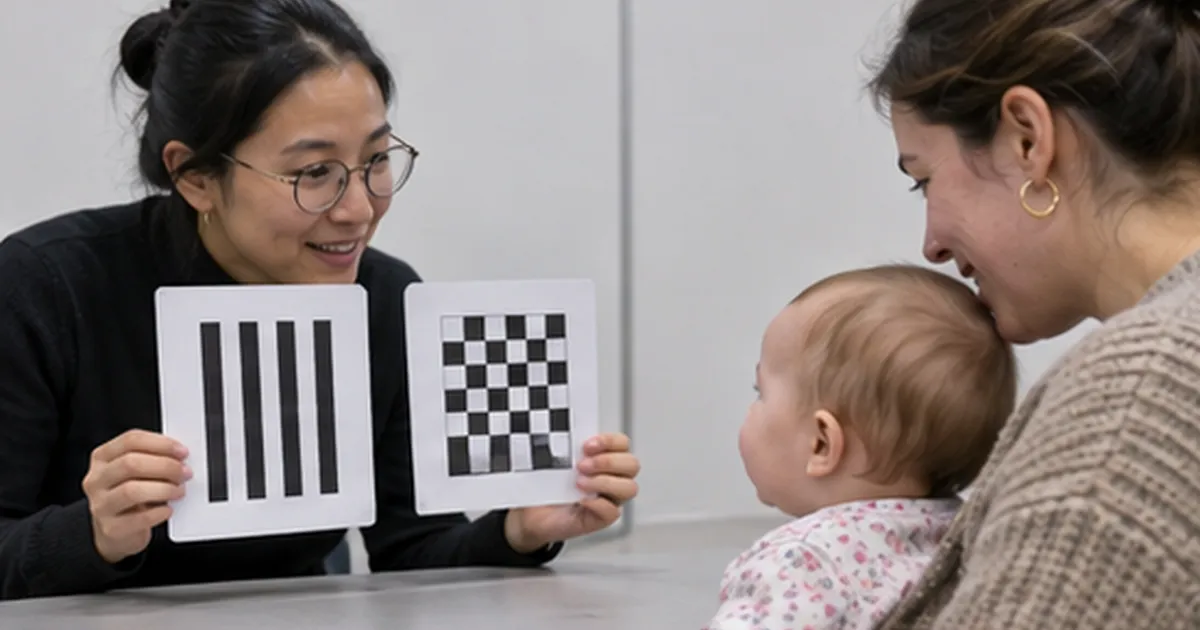
What can an infant study actually show? Not whether a baby likes red more than blue, nor whether they are smarter than average, but whether they notice a change—a shift in pattern, a violation of expectation. In a quiet, dimly lit lab room at the Northridge Child Cognition Center (a fictional setting), a 7-month-old infant named Maya sits on her mother’s lap, facing a screen. A red circle flashes on the left side for eight seconds. Then, a blue square appears on the right. Maya’s eyes flicker toward it. The researcher records the duration: 4.2 seconds. This is not about preference—it’s about detection. The looking-time paradigm, widely used in developmental psychology, measures how long infants look at stimuli, under the assumption that longer looks indicate surprise, novelty, or cognitive processing. But what can such a moment really tell us? Not what the infant feels, nor what they will become, but whether a difference in stimuli registers at all—a tiny window into early perception and expectation.
Designing the Looking-Time Study
In this illustrative study, researchers aim to test whether infants detect a change in object permanence cues. Forty infants are recruited: 20 at 6 months, 20 at 9 months. The design is cross-sectional—each infant tested once, at one age—allowing comparison across age groups but not tracking individual change over time. Each infant completes four trials: two with a ‘possible’ event (a toy car rolling behind a screen and reappearing), and two with an ‘impossible’ event (the car seeming to vanish behind the screen and not reappear). The order of trials is counterbalanced: ten 6-month-olds see the impossible event first, ten see the possible event first; same for the 9-month group. This counterbalancing controls for order effects—ensuring that any difference in looking time isn’t simply due to fatigue or habituation to the first trial.
The dependent variable is average looking time per trial type. Researchers define a ‘long look’ as any gaze lasting more than 3.5 seconds, based on pilot data showing that baseline fixation on static objects averages 2.8 seconds (SD = 0.6). Each trial begins when the infant fixates on the starting stimulus and ends when they look away for more than 1 second. Eye movements are tracked using infrared cameras, and data are coded offline by two independent observers, with 94% inter-rater agreement.
Results from the Fictional Data
At 6 months, infants looked at the impossible event for an average of 5.1 seconds (SD = 1.2), compared to 3.3 seconds (SD = 0.9) for the possible event. At 9 months, the difference was larger: 6.4 seconds (SD = 1.4) for the impossible event, 2.9 seconds (SD = 0.7) for the possible. A 2×2 mixed ANOVA (age group × event type) revealed a significant interaction: F(1, 38) = 9.7, p = 0.003. The main effect of event type was significant (p < 0.001), as was the main effect of age (p = 0.01). The 9-month-olds looked longer at the impossible event than the 6-month-olds did, and both groups looked longer at the impossible event than the possible event.
These numbers suggest that infants detect inconsistency in physical events—and that this sensitivity increases with age. But what exactly does that mean? The longer looking time at the impossible event implies detection of a discrepancy. It does not, however, demonstrate understanding of object permanence as a cognitive principle. Nor does it indicate preference. Looking time measures attention, not affect. The infant may stare not because they ‘know’ the car should reappear, but because the outcome is unexpected or visually salient.
Interpreting the Data: From Looking to Inference
Suppose Maya, the 7-month-old from earlier, looked for 5.8 seconds at the impossible event. That number, on its own, is meaningless. It gains meaning only in comparison: to her own baseline, to other infants, or to different conditions. The design allows researchers to distinguish between habituation (decreased looking over repeated exposure) and novelty detection (increased looking to new stimuli). In this case, the longer look at the impossible event suggests that infants treat it as novel or surprising.
Yet caution is required. A longer look could reflect mere perceptual salience—perhaps the disappearance creates a more dramatic visual shift. It could reflect confusion, not comprehension. Or it could be influenced by external factors: a sudden noise, the mother’s movement, the infant’s mood. The study controls for some of these through counterbalancing and standardized procedures, but not all. Moreover, the cross-sectional design limits claims about individual development. We see that 9-month-olds look longer than 6-month-olds, but we cannot say whether any single infant changed over time. That would require a longitudinal design, tracking the same infants across months.
Age and cohort are distinct. In this study, age is the variable of interest. But if the 6-month-olds were tested in January and the 9-month-olds in October, seasonal differences—lighting, illness rates, testing conditions—could confound results. A cohort effect would emerge if, for example, infants born in spring differ systematically from those born in fall. The current design cannot rule that out. Only a longitudinal study, following the same infants from 6 to 9 months, could disentangle age from cohort.
Looking vs. Preference: A Critical Distinction
One common misinterpretation of looking-time studies is equating gaze duration with preference. If an infant looks longer at a face than at a shape, does that mean they ‘like’ faces more? Not necessarily. They may simply process faces more slowly, or find them more complex. In this study, infants looked longer at the impossible event—but that does not mean they preferred it. In fact, in the fictional dataset, parental reports indicate that some infants cried during the impossible trials, suggesting distress rather than enjoyment.
Preference would require a different measure: choice, approach, or affective expression. Looking time is a measure of attention, not valence. Conflating the two leads to overstatement. For instance, if a later test shows that infants who looked longer at impossible events at 9 months score higher on a problem-solving task at 24 months, one might be tempted to say early ‘surprise detection’ predicts later performance. But that would confuse test performance with trait. The looking-time measure reflects momentary behavior, influenced by context, state, and method. It is not a stable trait like cognitive ability, which implies consistency across situations and time.
A Plausible Alternative: Perceptual Learning, Not Conceptual Insight
Consider an alternative explanation: infants are not reasoning about object permanence but learning perceptual patterns. The possible event—car rolls in, car rolls out—creates a predictable visual rhythm. The impossible event breaks that rhythm. Infants look longer not because they expect continuity, but because the disruption captures attention. This is a perceptual account, not a cognitive one.
Supporting this, the fictional data show that infants who looked longest at the impossible event also showed the greatest drop in looking time on repeated possible events—suggesting strong habituation to predictable sequences. Moreover, when researchers introduced a third condition—a car that changed color behind the screen—looking times were nearly as long as for the impossible event (5.9 seconds at 9 months). This implies that novelty, not logical inconsistency, may drive attention. The infant may not be tracking object identity but noticing change.
This alternative does not invalidate the original finding—it reframes it. The data still show that infants detect change. But they do not require a theory of mind or physical reasoning to explain it. Simpler perceptual learning mechanisms may suffice.
Transfer to Another Context: Workplace Learning and Attention Metrics
The logic of the looking-time study has parallels beyond infancy research. In a fictional corporate training program at NexaTech Solutions, instructional designers use eye-tracking to assess engagement with safety modules. Employees view two versions of a video: one with a standard sequence of steps, another where a critical step is omitted. Designers measure dwell time on the screen during the omission.
They find that employees spend 28% longer looking at the screen when the step is missing (mean = 4.7 seconds) versus when it is present (mean = 3.7 seconds). At first, they interpret this as evidence that employees ‘notice’ the error—proof of attentiveness. But a closer analysis reveals that dwell time increases most among employees who scored lowest on prior knowledge quizzes. High-knowledge employees barely slow their gaze.
Here, as with infants, longer looking does not equal better understanding. In fact, it may signal confusion. The high-knowledge group processes the sequence fluently; the low-knowledge group hesitates, rereading, searching for coherence. Just as in the infant study, attention (looking time) is not preference, nor is it a direct measure of comprehension. The designers revise their metric, pairing eye-tracking with post-test recall to better assess learning.
Moreover, the training team had initially tested employees from two departments at different times—sales in March, engineering in June. When they compare results, they see that engineering staff look longer on average. But was this due to department, or to testing in a noisier environment? Only by counterbalancing department and time, or using a within-subjects design, can they isolate the variable of interest.
Limitations and What the Data Can Actually Show
Back in the lab, the infant study’s findings are modest but meaningful. It shows that by 6 months, infants detect violations of expected visual sequences, and that this sensitivity increases over the next three months. It does not demonstrate that infants understand object permanence, nor that they ‘think’ like adults. It does not predict future cognitive performance. It does not reveal emotion or preference.
Observations do not by themselves demonstrate cause. The longer looking time correlates with event type and age, but does not prove that age causes increased sensitivity. Other factors—nutrition, sleep, home environment—could influence both age-related changes and attention. The study measures performance, not trait. And while the cross-sectional design allows age comparisons, it cannot confirm developmental trajectories.
What the study can show is a difference in information processing. It reveals that infants respond to inconsistency. It suggests that expectations begin to form early. But each inference must be qualified: limited by design, bounded by method, and open to alternative explanations. The power of the looking-time paradigm lies not in proving theories, but in creating puzzles—moments of surprise that invite further study, deeper questions, and careful distinction between what is measured and what is claimed.
For the wider context, read Roovet’s guide to developmental psychology across the lifespan or explore the developmental psychology course.