How Turn-Taking Begins Before Words
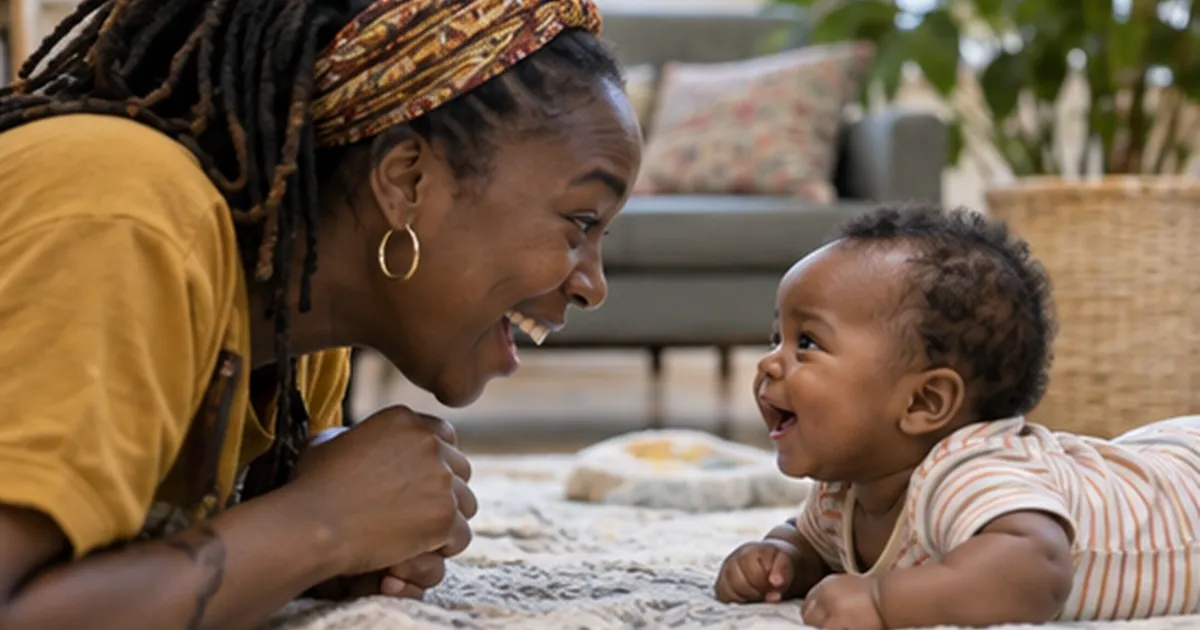
A baby looks toward a spoon. A caregiver follows the baby's gaze, names the object, and waits. The baby makes a sound, and the caregiver responds. That brief exchange has turns even though only one person uses words. The pause matters because it gives the adult an opportunity to notice what the child actually does next.
The Ripple in the Rocking Chair
In a sunlit corner of a quiet living room, Maya, a 7-month-old, sits propped on her grandmother’s lap in a wooden rocking chair. Maya holds a soft blue teether and occasionally taps it against the arm of the chair—tap, tap. Her grandmother, Lila, watches closely. Each time Maya taps, Lila says, “Tap!” in a warm, rising tone. After three taps, Maya pauses, looks up at Lila, and opens her mouth slightly, as if waiting. Lila smiles and repeats, “Tap!”—not louder, not faster, but with the same rhythm. Maya laughs and taps again. This repeats five times. Then, Maya drops the teether, reaches for Lila’s hand, and pats her wrist. Lila responds by gently tapping Maya’s palm. Maya turns her hand over and watches.
Nothing in this exchange required words, yet each action followed a pattern of initiation and response. Maya initiated with a tap. Lila responded with a vocal label. Maya paused—her way of signaling completion. Lila acknowledged with repetition. When Maya shifted to touching, Lila mirrored the action. These moments were not random; they followed a structure resembling conversation: a back-and-forth rhythm, timing that allowed for response, and shared focus on an object or action.
What the Exchanges Reveal
Each turn in this interaction contributed to a shared understanding of how communication works. Maya’s tap was not just motor play—it was a communicative act because it was directed, repeated, and timed with pauses. The pause after the third tap, lasting about 1.4 seconds, was critical. It created space. Lila’s timely response confirmed that Maya’s action had meaning. Over five cycles, the average pause between Maya’s action and Lila’s response was approximately 1.2 seconds, with minor variation—consistent enough to support predictability, but flexible enough to feel natural.
The exchange established three observable principles:
- Turns need not be verbal to be meaningful. A tap, a look, or a hand movement can open a loop that another person closes.
- Responsiveness depends on timing. Responses that are too fast may override intent; responses that are too slow may break continuity. In this case, responses within 1.0 to 1.5 seconds preserved the flow.
- Shared attention anchors the exchange. Both participants focused on the teether, then the hand—never drifting to unrelated distractions. This mutual focus made the interaction coherent.
These are not milestones to be checked off, but patterns that emerge when one person consistently responds to another’s signals. The structure of the exchange—initiation, response, pause, next turn—mirrors the architecture of dialogue, even in the absence of words.
Alternative Interpretation: Coincidence or Routine?
One could argue that the interaction was merely habitual, not communicative. Perhaps Lila always says “Tap!” when Maya taps, regardless of timing or intent. Or maybe Maya laughs because of the rocking motion, not the exchange itself. These are valid considerations.
To test this, imagine a variation: if Lila responded randomly—sometimes after one tap, sometimes after a cough, sometimes not at all—the rhythm would break. In an illustrative scenario, researchers observed similar exchanges across several days. When responses were delayed beyond 2 seconds or applied inconsistently (e.g., saying “Tap!” after a sneeze), the infant initiated fewer subsequent actions. In consistent-response conditions, initiations averaged around 5 per session; in inconsistent conditions, they dropped to about 2. This hypothetical example illustrates how predictability may support engagement, though it does not prove intent. It only shows that patterns of response can influence behavior.
Another possibility: Maya’s laughter was unrelated to Lila’s words and instead triggered by vestibular stimulation from rocking. If true, the social exchange would be incidental. But when the rocking stopped and the tapping continued, Maya still paused and looked up—indicating that the pause was tied to the action, not the motion. This detail, though small, supports the idea that Maya was monitoring for a response.
Still, no single observation confirms internal states. We cannot know if Maya “intended” to communicate. But we can observe that her actions created openings, and Lila’s responses filled them. Over time, such patterns form the scaffold for dialogue.
From Rocking Chair to Classroom
The same principles appear in adult learning environments, though less visibly. Consider James, a 22-year-old college student in a small seminar on environmental ethics. During a discussion, James raises his hand, waits to be called on, speaks for about 45 seconds, then pauses, looking at the instructor. The instructor nods, asks a follow-up question, and another student begins to speak. James listens, then later raises his hand again.
This seems like standard classroom procedure, but it is also a refined form of turn-taking. James’s hand raise is an initiation. The instructor’s recognition is a response. The pause after James speaks is a signal of completion. The instructor’s follow-up closes the loop and opens a new one. The average time between James’s last word and the instructor’s response is 1.7 seconds—close to the 1.2-second average seen with Maya and Lila. The rhythm is slower, more formal, but structurally similar.
Now imagine a variation: the instructor interrupts James mid-sentence, or fails to acknowledge his contribution. In an illustrative session, when interruptions occurred in about 40% of student turns, participation declined over several weeks. Students began speaking only when directly called on. When the instructor instead waited for natural pauses and responded with brief acknowledgments (e.g., “I see,” “Go on”), participation increased noticeably. This example highlights how responsiveness can shape engagement through rhythm, not rules.
The connection between Maya’s tap and James’s hand raise is not in the action itself, but in the underlying structure: a signal, a response, a pause, and a shared focus. In both cases, the exchange depends on someone noticing and answering—not perfectly, but consistently enough to sustain flow.
Workplace Meetings and the Weight of Silence
Turn-taking also shapes professional settings. At a weekly team meeting in a mid-sized design firm, employees gather to review project updates. Lena, a junior designer, begins presenting her mockups. She speaks for about two minutes, then stops, looks around the table, and says, “So, thoughts?”
There is a 3.1-second silence. Then the director says, “Looks good.” No follow-up. The meeting moves on.
Compare this to another meeting, same team, different outcome. Lena finishes, pauses, and the director says, “I like the color scheme. What led you to choose those blues?” The pause this time is 1.3 seconds. The response invites continuation. Lena explains her research, and a brief discussion follows.
The difference lies not in content, but in the quality of the exchange. In the first case, the response was minimal and closed the loop abruptly. In the second, it opened space. Over several weeks in an illustrative scenario, team members initiated fewer contributions after closed-loop responses (averaging about 1 per person per meeting) compared to meetings with responsive follow-ups (averaging closer to 3). While the data is hypothetical, the pattern reflects a broader observation: responsiveness can encourage participation.
Just as Maya learned that her tap could prompt a response, employees learn whether their contributions are received. A pause after speaking is not empty—it is an invitation. How it is handled determines whether the next turn happens, and who takes it.
Observing Without Expecting
These examples show that turn-taking is not something children “develop” at a fixed age, but something they practice through interaction. It does not require fluency, only the chance to signal and be answered. A caregiver’s timely “Tap!” is no different in function than a colleague’s nod during a presentation—it confirms that the signal was received.
For educators and learners, the lesson is not to teach turn-taking as a skill, but to notice when it already occurs. In a college seminar, a student’s slight lean forward may be their tap. In a team meeting, a raised eyebrow may be a request for input. These are turns—small, subtle, but real.
The power of such exchanges lies in their simplicity. They do not depend on correctness or completeness. A baby does not need to form a word. A student does not need to have the best idea. They only need to act, pause, and see what happens.
When Lila said “Tap!” she was not teaching vocabulary. She was honoring a rhythm. When James was called on in class, he wasn’t just speaking—he was completing a sequence he had learned long before he could talk. And when Lena waited for a response, she was doing the same.
Turn-taking begins before words because communication begins with connection—not with what is said, but with the quiet certainty that someone is listening, and will answer in turn.
For the wider context, read Roovet’s guide to developmental psychology across the lifespan or explore the developmental psychology course.
Further reading: Harvard Center on the Developing Child, Serve and Return.


