Middle School Online History: Read a Photograph Like a Source
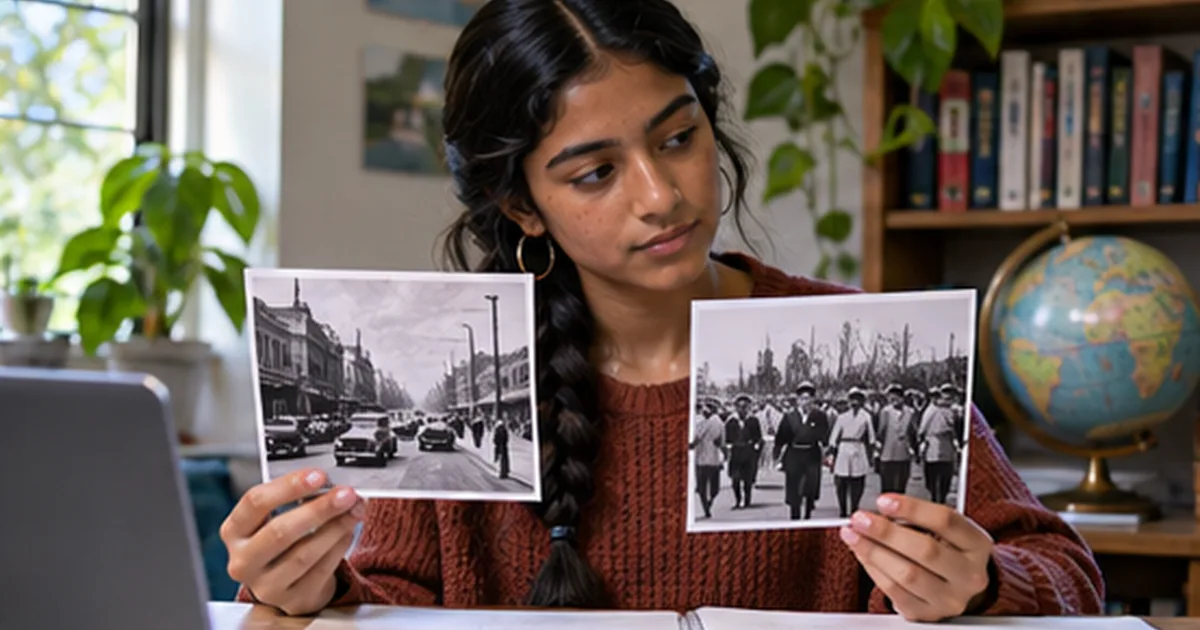
When 13-year-old Maya Rodriguez clicked on a black-and-white image in her online history lesson, she didn’t just see a dusty street and a group of people standing near a broken-down wagon. She saw a mystery. Her assignment: What can you learn from this photograph alone? This moment—common in Roovet Academy’s middle school online history courses—illustrates a foundational skill: reading a photograph not as a passive viewer, but as a critical historian. Unlike textbooks that present conclusions, Roovet’s approach teaches students to interrogate visual sources, separating what they observe from what they infer, and then testing those inferences against other evidence.
Photographs are powerful. They feel immediate, authentic, and self-explanatory. But in historical study, especially at the middle school level, that sense of certainty can be misleading. A photo captures a single moment, framed by choices—what’s included, what’s left out, who took it, and why. Teaching students to decode these choices builds analytical habits that transfer across subjects. Roovet Academy emphasizes this skill not as a one-off activity, but as a repeated practice woven into history units, from colonial America to the civil rights movement.
Consider the fictional photograph titled "Market Street, Millerton, July 1932", used in a Roovet lesson. It shows a narrow street lined with brick storefronts. A horse-drawn wagon sits askew near a pile of crates. Two men in overalls stand nearby, one gesturing toward the wheel. A woman in a long dress holds a child’s hand. A sign on a building reads "Feed & Seed." A newspaper blows across the pavement. Students are asked: What do you see? What might this tell us about life here?
Step One: Anchor in Observation
The first task is pure observation—listing only what is directly visible, without interpretation. This step grounds analysis in evidence. For the Millerton photo, students might record:
- A dirt street with wagon ruts
- Brick buildings with awnings
- A broken front wheel on a wooden wagon
- Two adult men, one pointing at the wheel
- A woman and young child standing apart
- A "Feed & Seed" sign
- A loose newspaper on the ground
- Overcast sky
- Shoes with worn soles visible on one man
Notice what’s missing from this list: no mention of poverty, no assumption that the wagon broke down due to poor maintenance, no claim that the child is hungry. Those are inferences. Observation is the foundation; everything else rests on it.
From Observation to Inference: The Critical Leap
Inference is where thinking deepens—but also where errors creep in. An inference is a logical guess based on evidence. The key is linking each inference directly to an observed detail.
For example, seeing the "Feed & Seed" sign, a student might infer: This town relies on agriculture. That’s reasonable. But if they say: The store is failing, based only on the sign, that lacks support. However, combining the sign with the broken wagon, the worn shoes, and the newspaper blowing away could lead to a stronger inference: People in this town may be struggling economically.
Maya, working through this lesson, wrote: The wagon wheel is broken, so transportation might be unreliable. The man is pointing at it, so maybe he’s trying to fix it or explain the problem. The woman and child aren’t helping, so maybe their roles are different. Her teacher responded by asking: What if the woman is the wagon owner? What if she’s waiting for help? What other sources could tell us? This exchange pushes beyond assumptions about gender roles to consider alternative explanations.
Why This Matters for Middle School Learners
At this age, students often conflate observation with opinion. They’ll say, The people look sad, when the photo doesn’t show facial expressions clearly. Or they’ll assume historical people shared modern values. Guided photo analysis disrupts this by requiring evidence for every claim.
Roovet’s curriculum builds this skill progressively. In early units, prompts are highly structured: List three objects. Name one person’s possible job. What time of year might it be? Later, students encounter photos with conflicting narratives—say, a Depression-era relief camp photographed by a government worker versus a journalist. They learn that the same image can be used to support different arguments.
Corroborating with Other Sources
Observation and inference are only half the process. The final step is corroboration: checking a photo’s story against other sources. A photograph suggests; it rarely proves.
After analyzing the Millerton image, students read a short excerpt from a 1932 newspaper article describing a drought in the region and declining crop prices. They also examine a map showing Millerton’s location in a farming county. With these, they revisit their inferences. Did the drought affect transportation? Could the broken wagon reflect broader economic strain?
One student, Jordan Lee, initially inferred that the broken wagon meant poor craftsmanship. After reading about the drought, he revised his view: Maybe parts are hard to get because money is tight, not because the wagon was badly made. This shift—from blaming individuals to considering systemic factors—is a hallmark of historical thinking.
Common Pitfalls and How to Avoid Them
Even with training, students stumble. Here are frequent missteps and how Roovet’s method addresses them:
- Assuming intent: Saying the photographer wanted to show poverty, without evidence. Remedy: Ask, What choices did the photographer make? Can we know their goal?
- Overgeneralizing: Claiming one photo represents all of rural America. Remedy: Compare multiple images from different regions.
- Presentism: Judging past people by modern standards. Remedy: Use period-appropriate sources to reconstruct context.
- Ignoring absence: Not questioning what’s not in the frame. Remedy: Prompt, Who might not be visible here? Why?
For instance, the Millerton photo shows no African American residents. A student might note this absence and ask whether segregation limited access to this part of town. That question can lead to research on local history—without the curriculum asserting a conclusion.
Applying the Skill Across Topics
This method isn’t limited to rural history. In a unit on the 1960s civil rights movement, students analyze a photo of a lunch counter sit-in. Observation: five young people in formal clothes, white counter staff in the background, empty stools. Inference: the protesters are making a statement about service equality. Corroboration: a news report from the event, a transcript of a participant interview.
Another example: a 1950s suburban neighborhood photo. Observation: identical houses, station wagons in driveways, no sidewalks. Inference: postwar housing demand led to rapid, uniform construction. Corroboration: a map of highway expansion, a short reading on federal mortgage policies.
Each exercise reinforces the same core: What do you see? What can you reasonably guess? What else do you need to know?
Tools for Parents and Educators
You don’t need a formal curriculum to practice this skill. Here’s how to guide a middle schooler through photo analysis:
- Choose a historical photograph—museums and library archives often have free collections online.
- Ask: What are three things you can see for sure? Write them down.
- Ask: What do you think is happening? What detail makes you say that?
- Find one other source—a short article, a map, a diary entry—and ask: Does this support or challenge your idea?
- Discuss: What still isn’t clear?
The goal isn’t to find the “right” answer, but to practice reasoning with incomplete information—a skill as valuable in science and civics as in history.
Building Analytical Confidence
One of the quiet benefits of photo analysis is how it levels the playing field. Some students struggle with dense texts but thrive when given a visual entry point. Others who dominate discussions based on prior knowledge must slow down and justify each claim with evidence.
In Roovet’s online environment, students submit written responses to photo prompts and review anonymized peer examples. This exposes them to different interpretations and encourages revision. When Maya saw a classmate’s response noting the absence of cars as a sign of economic hardship, she added a similar point to her own work. The discussion wasn’t about who was right, but how each conclusion connected to the image.
Teachers play a key role by asking questions, not giving answers. A simple What makes you say that? redirects students to evidence. Over time, they begin to ask it of themselves.
Extending Beyond the Screen
The habits formed in analyzing a 1930s photograph transfer directly to modern media literacy. When students see a photo on social media, they can pause and ask: What’s shown? What’s not? Who took this? What might they want me to believe?
One Roovet parent reported that her son started questioning viral images shared in family group chats. He asked where it was taken and if the caption matched, she said. I hadn’t thought to do that.
For families exploring homeschooling options or supplementing schoolwork, developing these habits early creates a foundation for independent learning. History becomes less about memorizing dates and more about practicing judgment.
Back in the fictional Millerton photo, the newspaper on the ground remains unreadable. No lesson reveals its headline. That ambiguity is intentional. The power of the exercise isn’t in solving the image, but in learning how to question it. In a world saturated with images, that skill is not just educational—it’s essential.
Explore Roovet Academy’s united states history and civics course.