Online Elementary Math: Teach Place Value With Everyday Objects
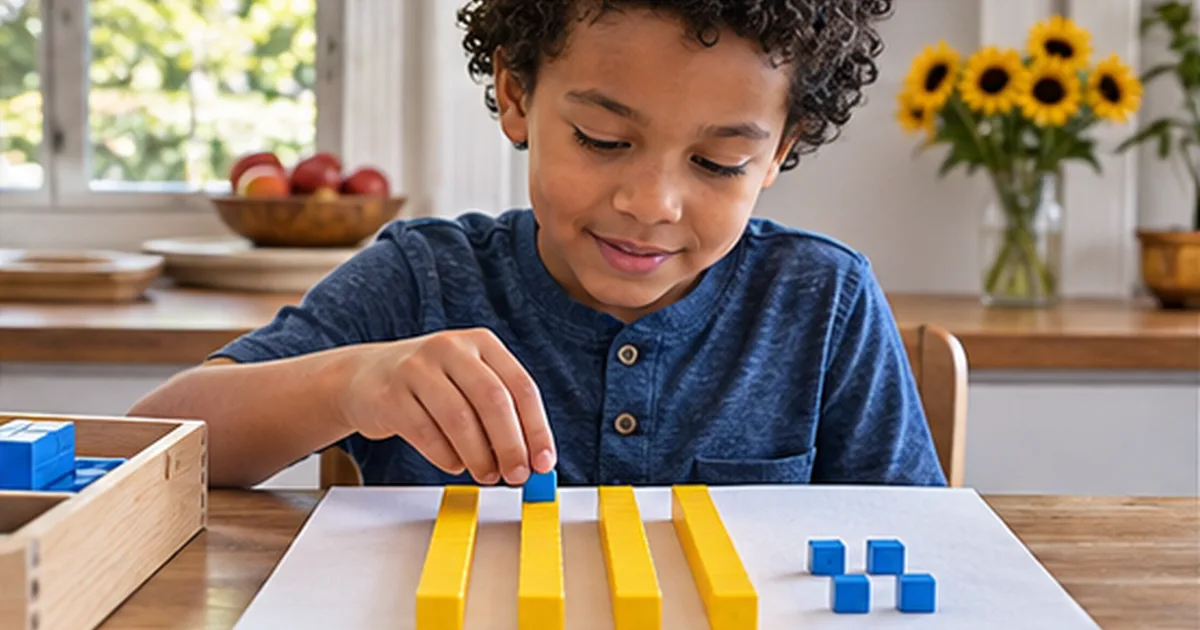
Set out four groups of ten counters and two loose ones. Ask a child to remove seventeen. The moment they reach for seven loose counters and find only two is the reason to teach an exchange: one group of ten can become ten ones without changing the total. Connect that physical move to the written subtraction as you work.
Roovet Academy supports families in building meaningful learning experiences at home, offering structured courses and resources designed to complement real-world exploration. Explore Roovet’s course offerings to support your child’s math journey with aligned practice and guidance.
Why Place Value Is Hard for Young Learners
Children often memorize counting sequences without fully grasping what numbers represent. For example, a student might recite “17, 18, 19, 20” fluently but struggle to explain why 20 is greater than 17 in a meaningful way. The challenge lies in the abstract nature of our base-ten number system. The digit '2' in 23 stands for twenty, not two, and this shift in value based on position is not intuitive at first.
Consider Mia, a hypothetical second grader in an online elementary school program. She can solve 10 + 5 quickly but hesitates when asked to break 24 into tens and ones. Without concrete models, she sees numbers as fixed symbols rather than flexible groupings. This gap becomes evident when she attempts subtraction with regrouping, such as 42 – 17. She knows she can’t subtract 7 from 2 in the ones place but doesn’t understand why “borrowing” means taking a ten from the tens column and converting it into ten ones.
Using Everyday Objects to Model Tens and Ones
Household items provide accessible, low-cost manipulatives that make place value visible and tangible. The key is consistency: assign one type of object to represent ones and another to represent tens. This builds a clear mental model.
Here are several effective pairings using common items:
- Straws and rubber bands: Use single straws for ones. When ten are collected, bundle them with a rubber band to create a “ten.”
- Coins: Pennies as ones, dimes as tens. While dimes are worth ten cents, their physical form is smaller, so pairing them with visual aids (like a labeled mat) helps avoid confusion about size versus value.
- Legos or building blocks: Single bricks are ones. Connect ten to form a “tower” representing a ten. This also reinforces the idea of grouping.
- Dry pasta: Small macaroni for ones, grouped into cups of ten. Larger pasta like penne can represent tens if marked or colored.
Choose materials that are easy to handle and group. Avoid small items like beads if a child tends to mouth objects. The goal is to allow physical interaction that mirrors mathematical operations.
Building Numbers Step by Step
Start with simple number construction. Ask the child to build a number like 36 using their chosen materials. For example, with straws, they would place three rubber-banded bundles (tens) and six single straws (ones). Then ask: “How many tens? How many ones? What does the 3 mean in 36?”
This process helps solidify that 36 is not just a sequence of digits but a combination of 30 and 6. Repeat with numbers across decades—14, 52, 80, 7—to reinforce variability in both places.
Trading Ones for Tens: A Physical Model of Regrouping
The concept of “trading” is central to understanding regrouping. Children must internalize that ten ones equal one ten, and vice versa. This is not just a rule—it’s an exchange, like trading ten game tokens for one prize ticket.
To teach this, set up a “bank” using two bowls or labeled sections on a mat: one for ones, one for tens. Begin with a pile of 13 single straws. Ask the child to see how many tens they can make. They group ten, tie them, and move the bundle to the tens bowl. Now they have one ten and three ones—13. Reverse the process: give them two tens (bundles) and ask how many ones they’d have if they untied everything. The answer is 20 ones.
This physical act of bundling and unbundling builds fluency with equivalence. It also lays the groundwork for understanding regrouping in subtraction.
Subtraction With Regrouping: Solving 42 – 17
Let’s walk through a concrete example using the straw model. We’ll follow the experience of Jordan, a hypothetical third grader learning at home through an online elementary school curriculum.
Jordan is given the problem 42 – 17. He starts by building 42: four rubber-banded bundles (40) and two single straws (2). He then needs to subtract 17: one ten and seven ones.
He removes one ten bundle easily—that leaves three tens. But he only has two ones and needs to remove seven. He cannot take seven from two. This is the crisis point where many children get stuck.
Here’s where the physical model shines. Ask Jordan: “Do you have enough ones? No. Can you get more ones by breaking apart a ten?” He takes one of the remaining ten bundles, unties it, and adds the ten straws to the ones pile. Now he has 12 ones (the original 2 plus 10 new ones) and only two ten bundles left.
Now he can subtract: 12 – 7 = 5 ones remain. From the tens, he already removed one earlier, and now he has two left—so 20. The result is 20 + 5 = 25.
This process mirrors the standard algorithm but grounds each step in physical action. Jordan isn’t just “borrowing”—he’s actively converting a ten into ten ones. The regrouping is not a notational trick; it’s a real exchange.
Common Misconceptions and How to Address Them
Even with manipulatives, children may develop partial or incorrect understandings. Watch for these common errors:
- Counting bundles as one: A child might count each bundle as “one” instead of “ten.” To correct this, consistently count by tens when referring to bundles: “This is ten, twenty, thirty…”
- Ignoring place in written form: A child may write 32 as 3 + 2 = 5. Reinforce that digits have different values based on position. Use a place value mat labeled “Tens” and “Ones” to organize physical models.
- Overgeneralizing regrouping: Some children regroup even when it’s unnecessary, such as in 45 – 22. Emphasize that regrouping is only needed when the top digit in the ones place is smaller than the bottom digit.
Address these by returning to the concrete model. Ask the child to show you 45 – 22 with straws. They’ll see they can subtract 2 tens and 2 ones directly—no trading needed.
Transitioning to Abstract Notation
Once children are fluent with physical models, gradually introduce written notation alongside the manipulatives. Use a three-column layout: one for tens, one for ones, and one for the standard algorithm.
For example, solving 42 – 17:
- Build 42 with straws: 4 tens, 2 ones.
- Write 42 in the standard algorithm format.
- Attempt to subtract 7 ones from 2 ones. Recognize the need to regroup.
- Break one ten into ten ones. Now have 3 tens and 12 ones.
- Update the written problem: cross out 4, write 3 above it; cross out 2, write 12 above it.
- Subtract: 12 – 7 = 5; 3 – 1 = 2. Answer: 25.
Each written step should mirror the physical action. Over time, reduce reliance on manipulatives, but keep them available for new or challenging problems.
Extending the Concept to Larger Numbers
Once place value with tens and ones is secure, extend the model to hundreds. Use larger containers—like paper plates—to represent hundreds. For example, ten bundles of ten straws (100 straws) can be placed on a plate labeled “100.”
A student like Sam, a hypothetical fourth grader, might use this to solve 134 – 57. He builds 134 with one hundred plate, three ten bundles, and four ones. To subtract 57, he starts with ones: 4 is less than 7, so he needs to regroup. He breaks a ten into ten ones, giving him 14 ones. Now he can subtract 7, leaving 7 ones.
But now he has only two tens left and needs to subtract 5. He must regroup again: break the hundred into ten tens. Now he has 12 tens. Subtract 5, leaving 7 tens. The hundred is gone. Final result: 70 + 7 = 77.
This layered regrouping is complex, but the physical model makes each step visible and logical.
Integrating Real-Life Contexts
Connect place value to everyday situations to reinforce relevance. For example:
- Counting change: “How many dimes make 50 cents? How many ones make 50 pennies?”
- Grocery shopping: “If apples are 25 cents each, how many can we buy with two dollars?” (This involves converting 200 cents into groups of 25.)
- Calendar math: “We’ve been homeschooling for 42 days. How many full weeks is that?” (7 days per week, so 42 ÷ 7 = 6.)
These applications help children see place value not as an isolated skill but as a tool for solving real problems.
Supporting Online Learners With Hands-On Practice
Families in online elementary school settings may worry that digital curricula lack tactile components. However, the flexibility of home-based learning allows for intentional integration of physical activities. Schedule short, focused sessions with manipulatives before or after digital lessons to build conceptual understanding.
For example, if a child completes an online quiz on place value and misses several items, don’t just repeat the digital exercise. Instead, pull out the straws and rubber bands and rebuild the numbers involved. This diagnostic use of manipulatives helps identify whether the error is conceptual (misunderstanding value) or procedural (misapplying steps).
Roovet Academy offers resources that align with hands-on learning strategies. Visit homeschool support for activity guides and structured math units that integrate seamlessly with household materials.
Teaching place value with everyday objects transforms an abstract concept into a tangible, logical system. By grounding math in physical experience, parents empower children to understand not just how to compute, but why the operations work. This foundation supports all future mathematical learning—and it starts with something as simple as a bundle of straws.
Explore Roovet Academy’s early elementary math course.