Seventh Grade Online Math: Learn Ratios With Scale Drawings
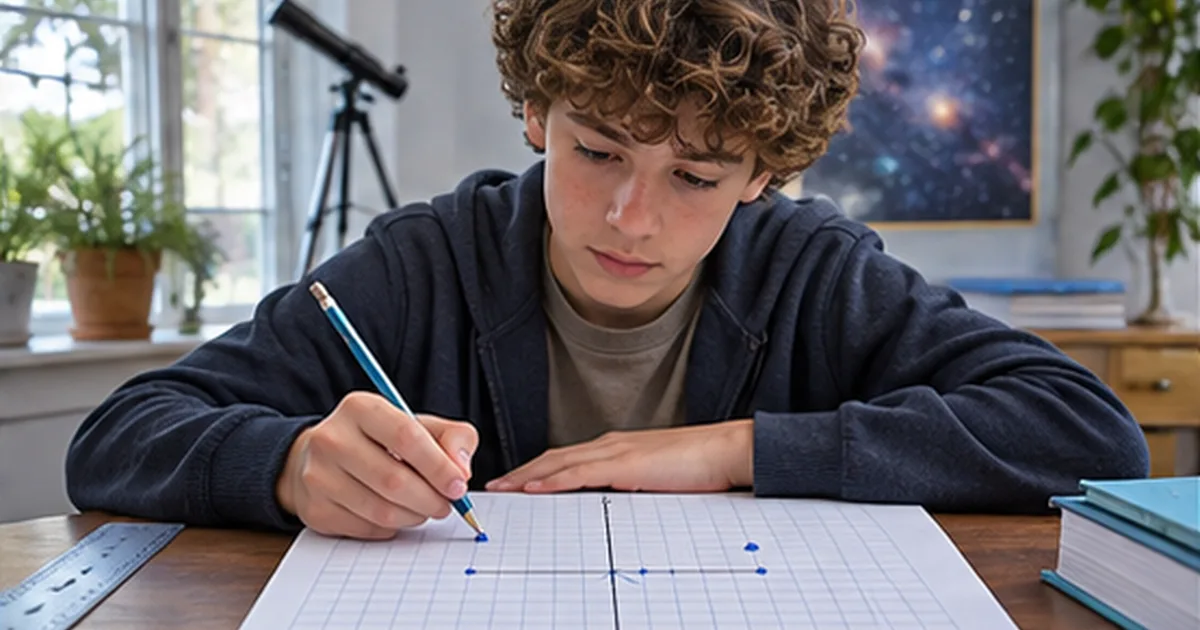
Seventh grade math introduces ratios in practical, visual ways—especially through scale drawings. These tools turn abstract concepts into tangible problems, helping students grasp proportionality. In online learning environments, such as those offering homeschool math courses, learners engage with digital blueprints, interactive grids, and real-world scenarios to build fluency with ratios and conversions. This article examines how scale drawings serve as a bridge between mathematical theory and everyday application, using hypothetical but representative student experiences to illustrate common challenges and effective strategies.
Understanding Ratios Through Scaled Floor Plans
Imagine a student named Maya, working through a 7th grade online math module. She's presented with a scaled bedroom plan: a rectangle labeled 4 inches by 6 inches, with a note stating the scale is 1 inch = 2 feet. Her task is to determine the actual area of the room.
At first, Maya multiplies the drawing dimensions: 4 × 6 = 24 square inches. She almost stops there—but the question asks for square feet. This is where many students stumble. They apply the scale linearly but forget that area scales by the square of the factor.
The scale is 1 inch = 2 feet. So each inch on the drawing represents 2 feet in reality. Therefore:
- Length: 4 inches × 2 feet/inch = 8 feet
- Width: 6 inches × 2 feet/inch = 12 feet
The actual area is 8 ft × 12 ft = 96 square feet.
Had Maya applied the scale directly to the area (24 in² × 2 ft/in = 48 ft²), she would have been wrong. Area conversions require squaring the scale factor. Since 1 inch represents 2 feet, 1 square inch represents (2 ft)² = 4 square feet. Thus, 24 in² × 4 ft²/in² = 96 ft²—same answer, different path.
Common Misconceptions in Scale Conversion
Many students assume that if a scale is 1:2, then area scales the same way. This is incorrect. A linear scale of 1:2 means lengths double, but areas quadruple. This principle applies universally, whether in architecture, model building, or map reading.
Consider another example: a scale drawing of a backyard uses 0.5 inches to represent 3 feet. What is the scale factor in simplest form?
First, convert both measurements to the same unit. Since 3 feet = 36 inches, the ratio is 0.5 in : 36 in. Multiply both sides by 2 to eliminate the decimal: 1:72. So, the drawing uses a 1:72 scale.
Now, if a pool in the drawing measures 1.25 inches by 0.75 inches, what are the real dimensions?
- Length: 1.25 in × 72 = 90 inches = 7.5 feet
- Width: 0.75 in × 72 = 54 inches = 4.5 feet
Students often skip unit conversion back to feet, leaving answers in inches. But real-world context demands meaningful units. This is where online instruction can insert immediate feedback—prompting learners to reconsider units before submitting answers.
Why Units Matter in Proportional Reasoning
Ratios only make sense when units are consistent. A frequent error is mixing feet and inches without conversion. For instance, a student might see “1 inch = 2 feet” and write the ratio as 1:2, not realizing that one side is in inches and the other in feet. The correct ratio, in like units, is 1 inch : 24 inches, or 1:24.
This distinction is crucial. If a drawing uses a 1:24 scale, then:
- A 3-inch hallway is 3 × 24 = 72 inches = 6 feet long.
- A 4.5-inch wall is 4.5 × 24 = 108 inches = 9 feet long.
Understanding that scale ratios must be unitless (after conversion) helps avoid compounding errors in multi-step problems.
Designing a Bedroom: A Project-Based Approach
Online math curricula often include project-based tasks. Take Jordan, another hypothetical 7th grader enrolled in a homeschool math program. His assignment is to design a scale drawing of his own bedroom.
First, he measures his room: 12 feet by 15 feet. He chooses a scale of 1 inch = 3 feet to fit the drawing on paper. To find the drawing dimensions:
- Length: 15 ft ÷ 3 ft/in = 5 inches
- Width: 12 ft ÷ 3 ft/in = 4 inches
He draws a 5-inch by 4-inch rectangle. Then he adds a bed measuring 6 feet by 3 feet. Converting to scale:
- Bed length: 6 ft ÷ 3 = 2 inches
- Bed width: 3 ft ÷ 3 = 1 inch
He places a 2 in × 1 in rectangle inside the room outline. This hands-on task reinforces ratio application and spatial reasoning.
But suppose Jordan mistakenly uses the scale as 1 inch = 3 inches instead of 1 inch = 3 feet. His drawing would be wildly inaccurate. Online platforms can prevent this by requiring students to label scales with units and validate inputs before proceeding.
Choosing an Appropriate Scale
Not all scales are equally useful. A scale that’s too small makes details indistinct; one that’s too large won’t fit on the page. Students must balance accuracy and space.
Suppose a classroom is 30 feet long. On an 8.5-inch-wide paper, what’s the largest usable scale?
Let’s test a few options:
- 1 in = 4 ft → 30 ÷ 4 = 7.5 in (fits)
- 1 in = 3 ft → 30 ÷ 3 = 10 in (too long)
- 1 in = 5 ft → 30 ÷ 5 = 6 in (fits, but less detail)
So 1 in = 4 ft is acceptable. But if the room were 40 feet long, 40 ÷ 4 = 10 inches—still too big. Then 1 in = 5 ft (8 in) or 1 in = 6 ft (6.67 in) would work better.
Students learn to evaluate trade-offs: higher detail versus page constraints. This decision-making mirrors real design work and strengthens proportional thinking.
Maps and Real-World Applications
Scale isn’t limited to floor plans. Maps use ratios to represent large distances. A common example: a map scale of 1 inch = 10 miles.
If two cities are 3.5 inches apart on the map, how far are they in reality?
3.5 in × 10 mi/in = 35 miles.
Now, what if the scale is given as 1:63,360? (This is common on some maps, as 1 mile = 63,360 inches.) To find the real distance between two points 2.4 inches apart:
2.4 in × 63,360 = 152,064 inches.
Convert to miles: 152,064 ÷ 63,360 = 2.4 miles.
Notice that 2.4 inches on the map equals 2.4 miles in reality. This isn’t a coincidence. Because 1 mile = 63,360 inches, a 1:63,360 scale means 1 inch on the map represents 1 mile. So any measurement in inches directly equals the number of miles in distance.
This elegant relationship helps students see the power of consistent units and thoughtful scale selection. It also reveals how professionals streamline complex data.
Addressing the “Scale Is Just Multiplication” Fallacy
Some students treat scale conversion as simple multiplication without considering context. For example, given a 1:10 scale model of a car that is 180 inches long, they correctly compute 180 ÷ 10 = 18 inches. But when asked for the model’s wheel diameter—say, 24 inches in real life—they may forget to scale it down: 24 ÷ 10 = 2.4 inches.
The key is consistency: every linear dimension must be scaled by the same factor. This includes height, width, depth—even the diameter of small parts.
Online exercises can reinforce this by requiring students to scale multiple features. For instance, a problem might show a scale drawing of a bookshelf with labeled shelves and ask for the real height of the third shelf. This prevents rote answers and promotes attention to detail.
Scaling Area and Volume: Beyond Length
While 7th grade standards focus on ratios and scale in two dimensions, early exposure to area and volume scaling builds strong foundations.
Take a square garden drawn at 1 cm = 5 m. The drawing shows a 3 cm × 3 cm patch. The real area is:
- Side length: 3 cm × 5 m/cm = 15 m
- Area: 15 m × 15 m = 225 m²
Alternatively, since area scales by the square of the linear factor, (5)² = 25. The drawing area is 9 cm². 9 × 25 = 225 m².
For volume, consider a 1:10 scale model of a fish tank. If the model holds 2 liters, the real tank holds 2 × (10)³ = 2 × 1,000 = 2,000 liters. This cubic relationship is important in engineering and design—but often surprises students.
While volume may be beyond strict 7th grade expectations, introducing the idea during ratio units can spark curiosity and prepare learners for future math.
Using Digital Tools to Visualize Scale
Online platforms offer dynamic tools that paper cannot. A student can drag a slider to adjust a scale and instantly see how a room’s drawing shrinks or expands. They might overlay different furniture options, each automatically scaled.
For example, a learner could be asked: “If you change the scale from 1 in = 2 ft to 1 in = 4 ft, how does the drawing size change?”
Using the earlier bedroom (8 ft × 12 ft):
- At 1 in = 2 ft: 4 in × 6 in
- At 1 in = 4 ft: 2 in × 3 in
The drawing becomes half as long and half as wide—so one-fourth the area. This visual feedback reinforces the inverse relationship between scale factor and drawing size.
Digital environments also allow instant error checking. If a student enters a dimension without units, the system can prompt for clarification. This supports precision—a key math practice standard.
Supporting Diverse Learners in Online Math
Students come to ratios with varied backgrounds. Some grasp scaling quickly; others struggle with unit conversion or fraction multiplication. Online instruction can adapt by offering layered support: optional video walkthroughs, hint systems, or alternate representations.
For instance, a struggling learner might benefit from a grid-based drawing where each square represents a fixed real-world size. Overlaying transparent grids at different scales can make proportional relationships visible.
Advanced learners can be challenged with open-ended tasks: “Design a scale model of your school with a maximum drawing size of 11 inches. Justify your chosen scale.” This requires research, measurement, and critical thinking.
In both cases, the core concept—ratios as comparisons of quantities—remains central. The flexibility of online learning allows for personalized pacing without sacrificing rigor.
From Classroom to Real-World Fluency
Ultimately, the goal of teaching ratios through scale drawings is not just to pass a test, but to build a habit of mind. When students see a map, a blueprint, or a model, they begin to ask: “What’s the scale? How do I use it?”
This fluency transfers across subjects and situations. A student reading a historical map can estimate distances. One building a model airplane understands why parts must match scale. These are not just math skills—they are tools for navigating the world.
By grounding abstract ratios in concrete, visual tasks, 7th grade online math helps students see the relevance of what they’re learning. And when learners like Maya and Jordan succeed—not through memorization, but through reasoning—they gain confidence that extends far beyond the screen.
Explore Roovet Academy’s pre algebra course.