Online Elementary Writing: Start a Nature Journal in Third Grade
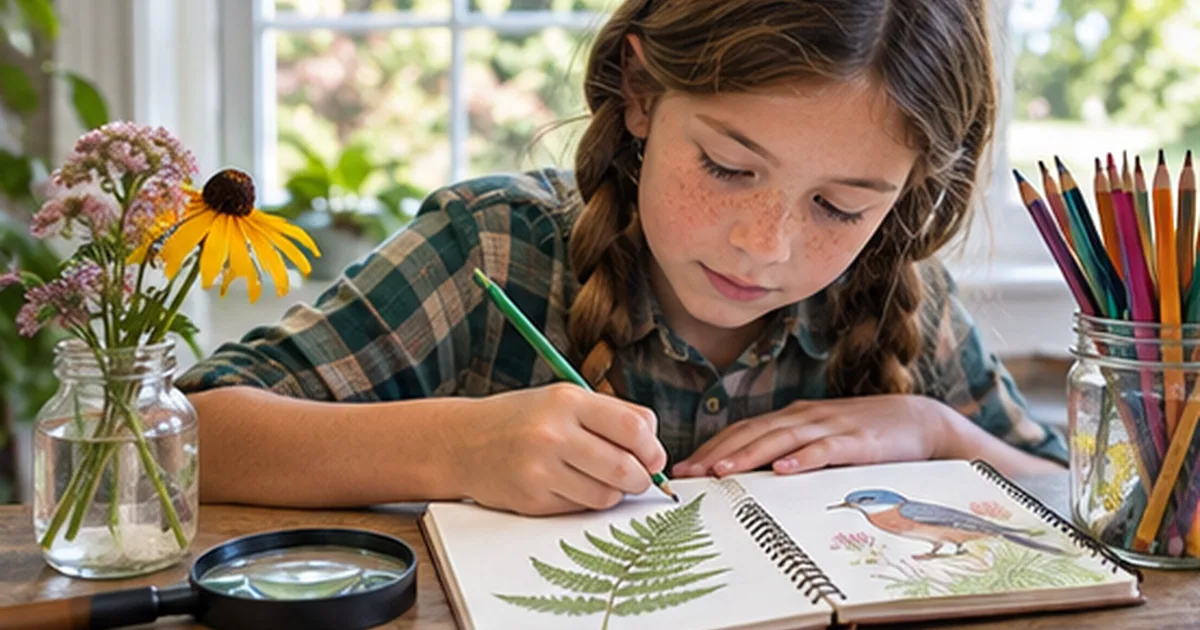
A third grader writes “green leaf” in a notebook and announces that the nature journal is finished. Instead of asking for a longer sentence, ask what would help a classmate recognize that particular leaf tomorrow. A pointed tip, a ragged edge, or a line of tiny holes gives the child evidence to work with. Revision begins with closer observation.
Why Nature Journaling Works for Third Grade Writers
Third grade is a pivotal year for writing development. Students shift from forming basic sentences to constructing coherent paragraphs with a central idea and supporting details. Nature journaling aligns perfectly with this transition because it provides a tangible subject—something the child has seen, touched, or heard—reducing the cognitive load of inventing content from imagination alone.
When a child watches a squirrel scramble up an oak tree, they’re not just passively observing. They’re gathering data: the color of the bark, the sound of rustling leaves, the speed of movement. These observations become raw material for writing. Because the experience is real, the student can revisit it mentally, making revision more authentic and less mechanical.
Consider Maya, a hypothetical third grader in suburban Ohio. With her family’s encouragement, she begins a weekly nature journal during spring. Her first entry reads: "I saw a bug. It was black and fast." While accurate, it lacks detail and structure. Over time, guided by consistent practice and thoughtful feedback, Maya learns to expand: "On Tuesday, I found a black beetle near the garden path. It moved quickly, scurrying under a rock when I stepped closer. Its shell looked smooth and shiny, almost like polished stone." This progression reflects growth in observation, vocabulary, and narrative flow.
From Observation to Draft: Building the First Entry
The key to turning field notes into a strong paragraph is scaffolding. Students benefit from a clear sequence: observe, record notes, draft, revise. Each step should be distinct, allowing the child to focus on one skill at a time.
Start with a short, structured outdoor session—10 to 15 minutes is sufficient. Equip the child with a notebook and pencil. Encourage them to choose one small area: a tree, a flower bed, or a puddle after rain. Prompt them with specific questions: What colors do you see? What sounds are nearby? Is anything moving? How does the air feel? These questions guide attention without dictating content.
After observation, the child writes rough notes. These don’t need to be full sentences. For example, 8-year-old Jordan in Colorado might jot: "Bird—brown, white belly, hops on sidewalk, pecks ground, flies to roof—chirp!" These fragments capture the moment and serve as anchors for later writing.
The next step is drafting. Help the child turn notes into a paragraph using a simple formula: Topic sentence → Details → Closing thought. For Jordan, this might become: "This morning, I watched a robin searching for food near our front steps. It had a white belly and a speckled chest. It hopped quickly and pecked at the ground several times. When it flew away, it landed on the roof and chirped loudly." This structure gives shape to raw observation without stifling voice.
Choosing the Right Focus
One common challenge is overloading the paragraph. Young writers may try to include every detail, resulting in a list-like passage. To avoid this, help the child select a single focus: behavior, appearance, or setting.
For instance, if the focus is behavior, the paragraph centers on what the creature or plant does. If it’s appearance, the child describes colors, shapes, and textures. A setting-focused entry might describe how the environment changes from morning to afternoon.
Let’s return to Maya. Her initial draft about the beetle included unrelated details: the temperature, a passing dog, and her own shoe. With guidance, she narrowed her focus to movement. Her revised paragraph reads: "The beetle I saw on Tuesday moved in quick, jerky motions. It ran straight for a crack in the stone path, then disappeared under a rock. I didn’t see it come out again." By limiting scope, her writing became clearer and more engaging.
Revising with Purpose: Beyond Spelling and Punctuation
Revision in third grade should go beyond correcting errors. It’s an opportunity to strengthen content and clarity. Use targeted questions to prompt deeper thinking:
- Can you add a detail about how it looked or sounded?
- What happened before or after the main event?
- Could you use a more precise word? (e.g., “ran” → “dashed,” “hurried”)
- Does the order of events make sense?
Take the case of Amir, a student in Arizona who observed a lizard on a rock. His first draft: "I saw a lizard. It was gray. It sat still. Then it ran." With revision prompts, he expanded: "On the hiking trail, I spotted a small gray lizard sunning itself on a flat rock. It didn’t move for nearly a minute. Then, suddenly, it darted behind a boulder and vanished." The revised version includes setting, duration, and a stronger verb, making the scene more vivid.
Using Time to Enhance Observation
One powerful technique is repeated observation. Ask the child to visit the same spot over several days. This builds patience and reveals change—key elements in narrative writing.
For example, a student might track a budding tree over a week. Day 1: tight green buds. Day 3: tiny leaves unfurling. Day 6: small branches swaying in wind. Compiling these notes into one paragraph teaches sequencing and comparison.
Such continuity also supports scientific thinking. Children begin to notice patterns: birds return at the same time each day, puddles shrink in sunlight. These insights enrich writing with authenticity and curiosity.
Supporting Online Learners with Consistent Feedback
In an online elementary school environment, consistent, constructive feedback is essential. Parents or learning coaches don’t need to be writing experts—just attentive readers. Focus on one or two elements per revision cycle.
For example, in the first round, praise clear details. In the second, suggest stronger verbs. In the third, help the child vary sentence length. This incremental approach prevents overwhelm and builds confidence.
Roovet Academy provides homeschool resources and a course catalog that include structured writing modules. These materials emphasize observation, drafting, and revision in ways that complement a nature journaling practice. Families using Roovet can adapt these tools to support writing development in real-world contexts.
Sample Revision Workflow
Here’s how a family might guide a child through turning notes into a final paragraph:
- Observe: Spend 10 minutes watching a garden spider at work.
- Note: "Web in corner. Spider in middle. Shiny legs. Fly got stuck. Spider moved fast."
- Draft: "I saw a spider in a web today. It had shiny legs and stayed in the center. A fly got caught, and the spider quickly wrapped it up."
- Revise (add detail): "Today, I noticed a garden spider in the corner of our porch. Its web glistened in the morning light. The spider, with long, shiny legs, waited motionless in the center. When a fly got caught, it darted out and wrapped the insect in silk within seconds."
This workflow emphasizes progression. The child isn’t expected to produce the final version immediately. Each step builds on the last, making the process manageable and educational.
Connecting Writing to Broader Learning
Nature journaling isn’t just a writing exercise—it bridges subjects. Describing a plant’s leaves introduces vocabulary like vein, stem, and texture. Recording animal behavior touches on life science. Noting weather patterns supports earth science concepts.
For instance, when 9-year-old Elena in Oregon documented a rainstorm over three days, her writing naturally incorporated changes in cloud cover, temperature, and plant response. Her paragraph evolved from "It rained a lot" to "On Monday, dark clouds rolled in by noon. By Tuesday, the garden was flooded, and the daffodils drooped under the weight of the water. By Wednesday, the sun returned, and puddles began to shrink." This reflects not only improved writing but also emerging environmental awareness.
Such interdisciplinary learning is a hallmark of effective homeschooling. It shows children that writing is not an isolated skill but a tool for understanding the world.
Keeping the Practice Sustainable
To maintain momentum, keep expectations realistic. One quality paragraph per week is more valuable than three rushed entries. Celebrate effort and improvement, not just polished results.
Use seasonal changes to inspire new topics: falling leaves in autumn, melting snow in winter, returning birds in spring. Rotate focus areas—sky, soil, insects, trees—so the child develops a broader observational lens.
Finally, model the behavior. When parents or siblings keep their own journals, even briefly, children see writing as a meaningful, shared activity—not just schoolwork.
With patience and structure, turning field notes into a revised paragraph becomes more than a writing task. For third graders in an online elementary school setting, it’s a way to connect curiosity with expression, building skills that endure far beyond the page.
Explore Roovet Academy’s english language arts 3 course.


