Fifth Grade Online: Run a Leaf Classification Investigation
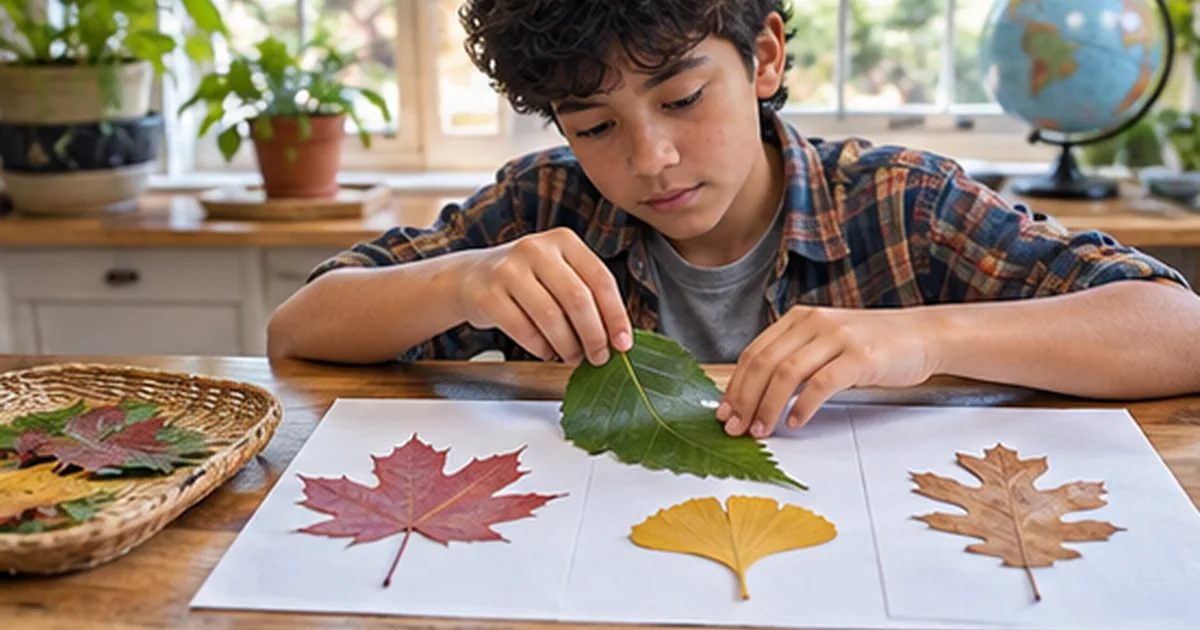
Hand a fifth grader a leaf they have never seen and a key they wrote yesterday. Can they identify its group without asking what “looks different” means? That test gives a classification project a purpose. Students build questions from visible traits, try the questions on unfamiliar samples, and revise the first branch that sends two people in different directions.
For families using Roovet Academy’s homeschool resources, this investigation supports structured science units that emphasize inquiry-based learning. The goal is not memorization, but the creation of a working two-choice (dichotomous) key based solely on observable traits—color, shape, edge, size, arrangement—without needing botanical names or expert knowledge.
Start with Observation: Collect and Compare Real Leaves
Begin by collecting leaves from at least five different trees in your yard, neighborhood, or local park. Choose trees that are easy to revisit, such as maple, oak, birch, pine, and elm. Ask your child to gather several leaves from each tree to observe natural variation.
At home, lay the leaves out on a table. Encourage your fifth grader to examine them closely using a magnifying glass if available. Prompt questions include:
- Are the leaves broad and flat, or narrow and needle-like?
- What shape is the overall outline—oval, heart-shaped, lobed?
- What do the edges look like—smooth, toothed, wavy?
- Are leaves arranged singly or in pairs?
- Is the surface shiny or matte?
Have your child record these observations in a notebook or on a simple chart. This step builds attention to detail and sets the foundation for classification.
Create a Dichotomous Key Step by Step
A dichotomous key is a tool scientists use to identify organisms by making a series of two-choice decisions. Each choice splits the group into smaller sets until only one remains. The key must be based only on observable traits—never on assumptions about species or names.
Work with your child to sort the leaves into two broad groups using a single, clear trait. For example:
- Step 1: Are the leaves needle-like or broad?
- Place all pine needles in one pile, broad leaves in another.
- Step 2: Among broad leaves, are the edges smooth or toothed?
- Maple leaves often have toothed edges; magnolia leaves are smooth.
- Step 3: Among toothed leaves, are they lobed or not?
- Maple leaves are lobed; beech leaves may be toothed but not deeply lobed.
- Step 4: Among lobed leaves, do they have pointed tips or rounded ones?
Each decision should be binary and unambiguous. Avoid vague terms like “kind of toothed” or “a little pointy.” Instead, define clear categories: “has teeth along the edge” vs. “no teeth visible.”
Example: Mia’s Key for Five Leaves
Meet Mia, a fifth grader in Portland, Oregon. She collected leaves from a pine, maple, birch, magnolia, and holly tree. She began sorting:
- Choice 1: Needle-like or broad?
- Pine → go to Step A
- Others → go to Step B
- Step A: Is the leaf a single needle or in clusters?
- Pine needles in clusters → likely pine
- Step B: Are the edges toothed?
- Maple, birch → yes
- Magnolia, holly → no
- Step C: Among toothed leaves, are they deeply lobed?
- Maple → yes → identified
- Birch → no → identified
- Step D: Among non-toothed, are the leaves waxy and thick?
- Magnolia → yes → identified
- Holly → no → thin, spiny → identified
- Requiring at least three leaves per tree for comparison
- Choosing traits that are consistent across multiple samples
- Revising the key when misidentifications occur
- Overlapping traits: Some birch and maple leaves both have toothed edges. Solution: add another level, such as “Are the teeth fine and close together (birch) or large and spaced (maple)?”
- Subjective terms: “Big” or “ugly” aren’t useful. Replace with measurable or visual criteria like “longer than 4 inches” or “has spines.”
- Too many choices at once: A dichotomous key must offer only two paths at each step. Avoid combining traits like “dark and shiny” in one choice.
- Leaf length in centimeters
- Number of lobes (if present)
- Stem length
- Color using standard names (green, yellow, red)
- 12 maple trees
- 6 oak trees
- 3 birch trees
- 1 pine tree
- a. Leaf is needle-like → go to 2a b. Leaf is broad → go to 2b
- a. Needles in clusters → pine b. Edges toothed → go to 3a c. Edges smooth → go to 3b
- a. Deeply lobed → maple b. Not lobed, waxy → magnolia
- Observation: Noticing subtle differences in shape, texture, and arrangement
- Pattern recognition: Seeing how traits group together across specimens
- Decision-making: Choosing which trait best splits the group at each step
- Revision: Updating the key when new data contradicts it
- Shoes in the household
- Types of birds seen at a feeder
- Local rocks or insects
Mia’s key worked consistently across multiple samples. She revised it when she found a birch leaf with slightly wavy edges—was that “toothed”? She decided to define “toothed” as having sharp, triangular projections, excluding gentle waves. This refinement improved accuracy.
Revise Based on Real-World Challenges
Classification isn’t always clean. Leaves from the same tree can vary due to age, sunlight, or damage. Teach your child to handle ambiguity by:
For example, if a maple leaf lacks clear lobes due to insect damage, does it still belong in the “lobed” group? Guide your child to use the healthiest specimen as the reference, but note exceptions in their journal.
Common Pitfalls and How to Avoid Them
Many children jump to conclusions based on color or size, which can be misleading. A young oak leaf may be smooth-edged, while an older one is deeply lobed. Focus on structural traits that are less variable.
Other common issues include:
Encourage your child to test the key with a friend or family member who hasn’t seen the original sorting. Can they identify a leaf using only the key? If not, revise the wording for clarity.
Extend the Investigation with Data Recording
To deepen learning, add simple data tracking. Have your child measure and record:
Then, create a simple table or chart. For example:
Maple: avg. length 12 cm, 5 lobes, toothed edge Birch: avg. 7 cm, no lobes, finely toothed edge Pine: 15 cm cluster, needle-like
This data can be used to refine the dichotomous key. Suppose a new leaf is 8 cm long with fine teeth but no lobes. Does it match birch more than maple? Data supports the decision.
Example: Jordan’s Neighborhood Survey
Jordan, a fifth grader in Cincinnati, used his leaf key to conduct a sidewalk survey. He walked three blocks and identified trees based on fallen leaves. He recorded:
He made a bar chart showing tree frequency in his area. He noticed oaks and maples were most common, which led him to research why certain trees thrive locally. This extension connected classification to ecology and community observation.
Support Logical Reasoning with Flow and Structure
A well-built key follows a logical flow from general to specific. Start with the most obvious, consistent differences—like needle vs. broad—then move to finer details.
Teach your child to write each step as a numbered pair:
This format ensures clarity and prevents circular reasoning. Each choice reduces the possibilities by half, leading efficiently to an identification.
When to Use Multiple Keys
If your area has many similar trees—like several types of oak—a single key may not suffice. In such cases, create separate keys for broad-leaf and needle-leaf groups. This modular approach prevents confusion and mirrors how professional botanists work.
Connect to Broader Science Skills
This project builds more than classification skills. It fosters:
These are foundational to scientific thinking. By grounding them in a real-world task, children internalize the process more deeply than through worksheets or videos alone.
Adapt for Different Learning Styles
For visual learners, use colored pencils to sketch each leaf and annotate traits. For kinesthetic learners, arrange leaves on the floor and physically move between groups as choices are made. For verbal learners, have them explain each step aloud or record a short video narration of their key in action.
Children with attention challenges may benefit from breaking the project into short sessions: Day 1—collect and observe; Day 2—sort into two groups; Day 3—build first two steps of the key; Day 4—test and revise.
Prepare for Outdoor Learning Safely
Always supervise outdoor collection. Teach children not to touch plants like poison ivy (look for “leaves of three”), and to wash hands after handling unknown vegetation. Use gloves if needed. Stick to public sidewalks or your own yard unless you have permission to enter private property.
Consider seasonal timing. Autumn offers a wide variety of fallen leaves, but spring and summer allow observation of leaves still on trees, which can reveal arrangement patterns (opposite vs. alternate) that aid identification.
Next Steps After the Project
Once the leaf key is complete, expand the concept. Try building a dichotomous key for:
These variations reinforce the logic of classification across domains. They also show children that science isn’t confined to textbooks—it’s a way of organizing the world.
For families using Roovet Academy, this leaf investigation complements science courses for elementary learners that emphasize hands-on exploration and structured inquiry. No special equipment is needed—just curiosity, a notebook, and access to the natural world just outside the door.
Explore Roovet Academy’s elementary science course.