Online Middle School Science: Design a Fair Ice-Melt Test
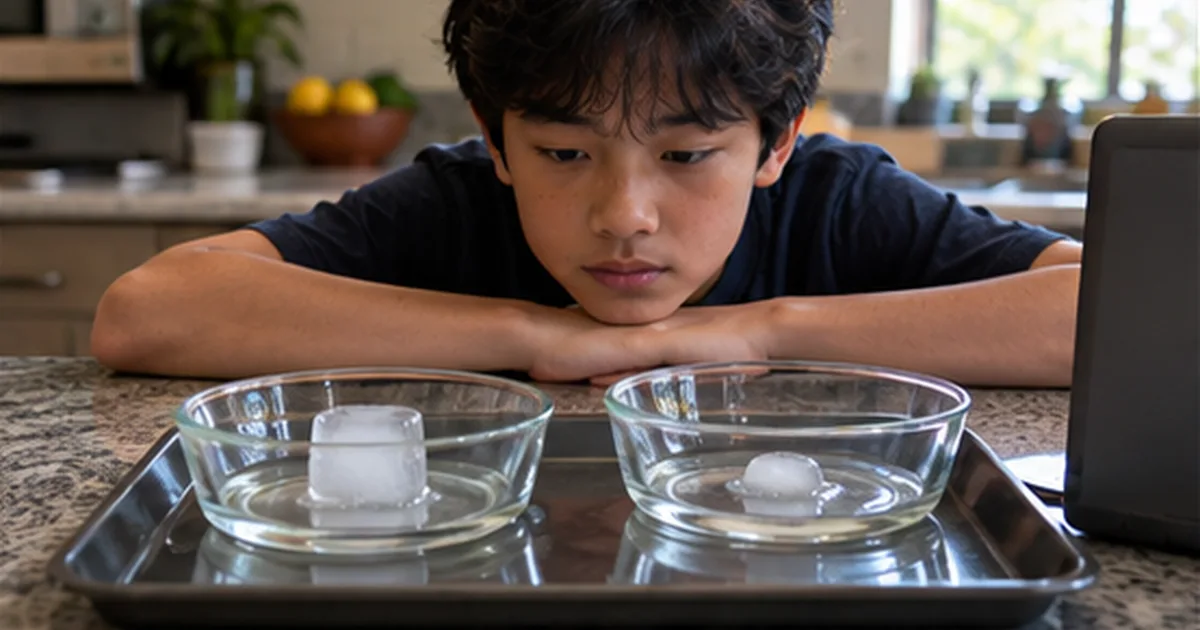
If two ice cubes melt at different speeds, what caused the difference? A student can answer only as precisely as the setup allows. Choose one change to test, decide what counts as “melted,” and use the same measurement rule for every trial. A kitchen-table experiment then becomes a lesson in how evidence supports a claim.
Roovet Academy supports learners in building these investigative skills through structured course activities and project guidance. Families exploring science curriculum options can learn more about how project-based learning is integrated by visiting Roovet Academy's course offerings. The following discussion illustrates how a student might approach the task of designing a fair ice-melt test, including hypothetical examples, reasoning, and decisions that mirror real classroom work.
What Makes a Test 'Fair'?
A fair test, also known as a controlled experiment, compares only one variable at a time while keeping all others constant. In the context of melting ice, a student might wonder: Does salt make ice melt faster than sugar or sand? To answer this fairly, only the substance sprinkled on the ice should differ. Everything else—ice cube size, container type, room temperature, timing method—must be identical across trials.
Without controls, results could mislead. For example, if one ice cube starts smaller than another, it may melt faster regardless of the substance used. That would not be a fair comparison. Students must plan carefully to avoid such errors.
Defining the Question and Variables
Let’s follow Maya, a hypothetical seventh-grade student in an online science course, as she designs her experiment. Her guiding question is: Which common household substance causes ice to melt the fastest?
She selects three substances to test: table salt (sodium chloride), granulated sugar, and fine sand. She also includes a control group with no substance added. This gives her four test conditions.
Maya identifies her variables:
- Independent variable: the substance applied (salt, sugar, sand, or none)
- Dependent variable: time for the ice cube to completely melt
- Controlled variables: ice cube size (2 cm³), container material (plastic petri dish), room temperature (22°C), start time, and observation frequency
By specifying these, Maya ensures that any differences in melting time can reasonably be attributed to the substance used, not to unrelated factors.
Planning Repeated Trials
One trial per substance isn’t enough. A single outlier—such as a draft near a window—could skew results. Repeated trials increase reliability. Maya decides to run three trials for each substance, for a total of 12 tests.
She documents her procedure:
- Freeze identical 2 cm³ ice cubes using a silicone mold.
- Place each cube in a labeled petri dish at room temperature.
- Immediately sprinkle 1 teaspoon of the test substance evenly over the cube.
- Start a timer and record the time when the last visible piece of ice disappears.
- Repeat for each substance, three times.
She performs all trials on the same day to minimize environmental changes. This consistency is part of maintaining a fair test.
Collecting and Recording Data
Maya creates a data table. After completing her 12 trials, she records the melting times in seconds:
- Salt: Trial 1: 410 s, Trial 2: 395 s, Trial 3: 405 s
- Sugar: Trial 1: 780 s, Trial 2: 760 s, Trial 3: 770 s
- Sand: Trial 1: 820 s, Trial 2: 830 s, Trial 3: 810 s
- No substance: Trial 1: 850 s, Trial 2: 840 s, Trial 3: 860 s
She calculates the average melting time for each substance:
- Salt: (410 + 395 + 405) ÷ 3 = 1210 ÷ 3 = 403.3 seconds
- Sugar: (780 + 760 + 770) ÷ 3 = 2310 ÷ 3 = 770 seconds
- Sand: (820 + 830 + 810) ÷ 3 = 2460 ÷ 3 = 820 seconds
- No substance: (850 + 840 + 860) ÷ 3 = 2550 ÷ 3 = 850 seconds
The data clearly show that salt reduces melting time significantly compared to the other conditions. Sugar, sand, and no substance yield similar results, with minor variation likely due to measurement precision.
Interpreting the Results
Maya observes that salt caused ice to melt in about 403 seconds, while the other conditions took over twice as long. She recalls from her online lessons that salt lowers the freezing point of water—a concept called freezing point depression. This scientific principle explains why road crews use salt in winter.
She notes that sugar also dissolves in water and might be expected to have some effect, but her data show it did not significantly speed melting. This leads her to a deeper question: Why does salt work better than sugar, even though both are soluble?
Through research and guided reading in her course, Maya learns that the number of particles a substance releases in water matters. Salt (NaCl) dissociates into two ions—Na⁺ and Cl⁻—per molecule, effectively doubling the particle concentration. Sugar remains as whole molecules. More particles mean greater disruption to ice formation, so salt is more effective.
This interpretation connects her data to molecular-level reasoning, a key goal in middle school science standards.
Addressing Experimental Limitations
Maya reflects on possible sources of error. For example, she noticed that in one salt trial, the ice cube cracked early, exposing more surface area. This could have accelerated melting independently of the salt. She records this observation in her lab reflection.
She also considers environmental factors. Although the room temperature was stable, one petri dish was slightly closer to a vent. Airflow could influence melting rate. In future trials, she would randomize the placement of samples or use a fan to create uniform airflow.
These reflections show scientific maturity—recognizing that real-world data aren't perfect and that improvement is part of the process.
Extending the Investigation
Based on her results, Maya proposes a follow-up experiment: Does the amount of salt affect melting time? She plans to test ½ teaspoon, 1 teaspoon, and 2 teaspoons of salt on identical ice cubes.
This new question shifts the independent variable from type of substance to quantity. She maintains all other controls. This kind of iterative inquiry—building on prior results—is central to scientific thinking.
She predicts that more salt will melt ice faster, but only up to a point. After a certain concentration, adding more salt may not make a difference. Testing this hypothesis will require careful measurement and repeated trials once again.
Supporting Online Learners in Experimental Design
Students like Maya benefit from structured guidance when designing experiments at home. Online middle school science programs can provide templates, video demonstrations, and feedback loops that help students plan, execute, and interpret investigations safely and effectively.
For families managing homeschool science, clarity in experimental design is essential. Projects like the ice-melt test align with core science practices: asking questions, planning investigations, analyzing data, and constructing explanations. These skills are transferable to other topics, from plant growth to circuit design.
One challenge in home-based science is ensuring access to materials. The ice-melt experiment uses common household items, making it accessible. Still, families should review safety—handling ice with dry hands to avoid cold burns, using plastic containers to prevent breakage, and supervising younger learners.
Connecting to Curriculum Goals
The Next Generation Science Standards (NGSS) emphasize inquiry and crosscutting concepts. A fair test like Maya’s touches on several:
- PS1.A: Structures and Properties of Matter: Adding salt disrupts the formation of ice, lowering its melting point.
- ETS1.A: Defining and Delimiting Engineering Problems: Designing a solution requires identifying criteria and constraints.
- Patterns: Observed trends in melting times reveal relationships between variables.
- Cause and Effect: The application of salt causes faster melting due to a known physical mechanism.
By aligning hands-on projects with these standards, online courses ensure that students are not just learning facts but developing scientific reasoning.
From Data to Understanding
Consider another hypothetical student, Jordan, who conducted a similar experiment but used rock salt instead of table salt. His average melting time was 430 seconds—slightly slower than Maya’s. He wonders why.
Upon reflection, Jordan realizes that rock salt crystals are larger and may dissolve more slowly than fine table salt, delaying the onset of freezing point depression. This insight leads him to refine his method: crushing the rock salt before application. In a second round of trials, the melting time drops to 408 seconds, closer to Maya’s result.
This example shows how variation in materials affects outcomes—and how thoughtful troubleshooting improves experimental design. It also highlights that science is iterative: one experiment often leads to another.
Conclusion
Designing a fair ice-melt test teaches middle school students more than just how salt affects ice. It builds skills in observation, measurement, control, repetition, and interpretation. When supported by structured online learning platforms like Roovet Academy, students can conduct meaningful science at home, using everyday materials to explore fundamental concepts.
Through projects like these, learners develop habits of mind that extend beyond the classroom. They learn to question assumptions, test ideas systematically, and revise conclusions based on evidence. For families navigating online middle school science, such investigations offer a concrete way to engage with the scientific method—one ice cube at a time.
For more information on integrating hands-on science into a home learning environment, explore project ideas and curriculum support at Roovet Academy's homeschool resources.
Explore Roovet Academy’s earth and space science course.