Online High School English: Revise an Essay in Three Passes
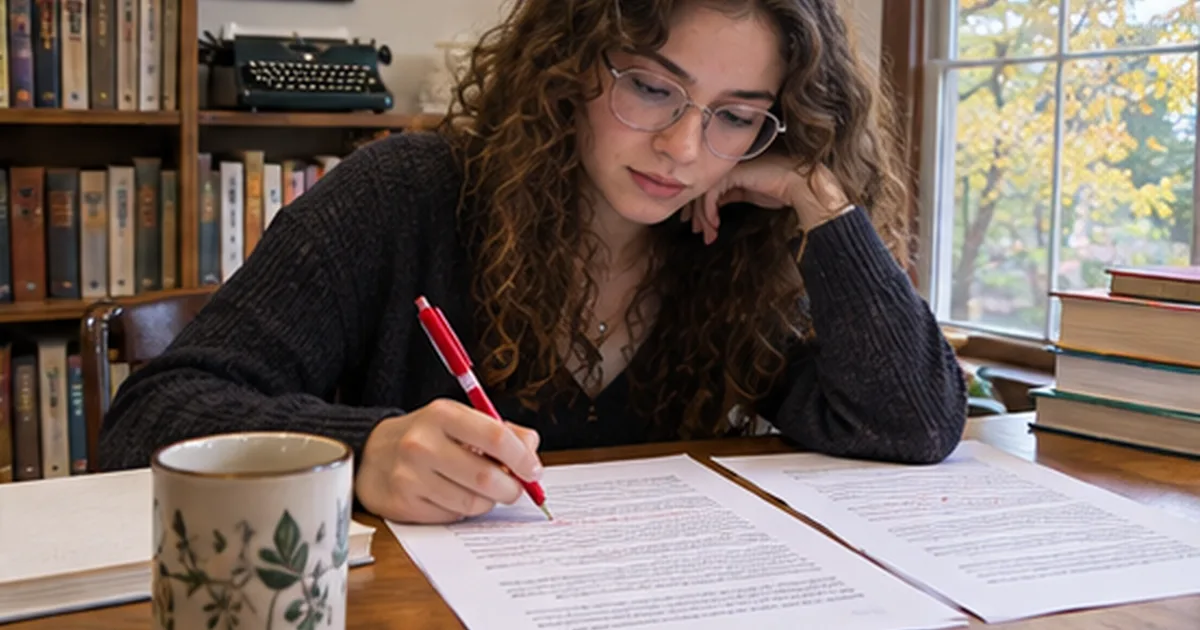
A student can polish every sentence in an essay and still leave the reader wondering what the argument is. Read the draft three times with a different job each time. First test the claim, then examine its evidence, and finally revise the sentences. The order matters because some of the sentences you could polish may disappear when the argument gets stronger.
Meet the Student: Jordan’s First Draft
Jordan, a 10th-grade student in an online high school English course, submitted an essay titled The Role of Technology in Modern Education. The prompt asked students to argue whether digital tools enhance or hinder learning. Jordan’s first draft was over 800 words but lacked focus, relied on vague claims, and included repetitive phrasing. Here’s an excerpt from the original:
Technology is very important in schools today. A lot of students use computers and tablets. It helps them learn better because they can look up things fast. Some people say technology is bad because kids get distracted. But I think it’s good overall because it prepares students for the future. The world is changing, and schools need to change too.
This paragraph contains a central idea but lacks evidence, specificity, and logical flow. Jordan’s argument is underdeveloped, and the tone is informal. Let’s apply the three-pass revision method to improve it.
Pass One: Structural Clarity
The first revision pass focuses on organization and logic. At this stage, ignore grammar and word choice. Instead, ask: Does the essay have a clear thesis? Are paragraphs unified around one idea? Is there a logical progression from introduction to conclusion?
For Jordan’s essay, the first step is identifying the thesis. The original draft implies support for technology but never states a clear position. A stronger thesis might read:
Digital learning tools enhance education by increasing access to information, supporting personalized learning, and fostering collaboration—provided schools implement them with clear guidelines.
With this thesis, Jordan now has a roadmap. Each body paragraph should address one of the three benefits listed. The current draft jumps between ideas without transitions. We revise by reordering paragraphs and adding topic sentences. For example:
- Paragraph 1: Technology improves access to up-to-date resources.
- Paragraph 2: Adaptive software allows students to learn at their own pace.
- Paragraph 3: Online collaboration tools build teamwork skills.
During this pass, we also eliminate redundant paragraphs. Jordan originally had two paragraphs saying similar things about "the future." We merge them into one concluding point. The goal is a skeleton that makes sense before we dress it in language.
Key Decisions in Pass One
- Clarify the thesis to include a nuanced position (acknowledging limitations).
- Reorder paragraphs to follow a logical sequence.
- Add topic sentences that preview each paragraph’s focus.
- Cut or combine sections that repeat ideas.
Pass Two: Strengthening Argument and Evidence
Now that the structure is sound, the second pass targets content. This is where students elevate their writing by replacing generalizations with specific examples, data, or references. Vague claims like "technology helps" must become precise.
Take Jordan’s original line: "Students can look up things fast." That’s a claim without support. In the revised version, we replace it with:
With internet-connected devices, students can access peer-reviewed articles, primary sources, and interactive simulations—resources that were once limited to university libraries.
This version adds concrete value. It shows what students access and why it matters. Similarly, instead of saying "technology prepares students for the future," we revise to:
As remote work and digital communication become standard, familiarity with online collaboration platforms—such as shared documents and video conferencing—equips students with practical workplace skills.
This grounds the argument in real-world relevance. We also add a counterargument paragraph to address distraction concerns:
Critics rightly note that unrestricted device use can lead to off-task behavior. However, structured classroom policies—like timed research sessions and monitored browsing—can mitigate these risks without sacrificing digital benefits.
This addition strengthens credibility by acknowledging complexity. It shows Jordan isn’t ignoring opposing views but engaging with them.
What to Add in Pass Two
- Specific examples: Name tools (e.g., Khan Academy, Google Docs) or types of resources.
- Real-world connections: Link classroom use to college or career skills.
- Counterarguments: Address one major opposing view with a rebuttal.
- Transitions: Use words like furthermore, however, and for instance to connect ideas.
Pass Three: Precision and Tone
The final pass sharpens language. This is where students move from "good enough" to polished. Focus on sentence variety, word choice, and eliminating filler. Avoid overusing "very," "really," or "a lot." Replace weak verbs like "is" or "has" with active alternatives.
For example, Jordan’s original sentence:
Technology is very important in schools today.
becomes:
Digital tools have become integral to modern classrooms, reshaping how students access knowledge and demonstrate understanding.
The revision removes "very" and "important," replacing them with precise language. "Reshaping how students access knowledge" is more descriptive than "is important." We also vary sentence length. Short sentences add impact; longer ones develop ideas.
Common Fixes in Pass Three
- Replace passive constructions: "Mistakes were made" → "The team overlooked key data."
- Trim redundancy: "end result" → "result"; "free gift" → "gift."
- Use strong verbs: "make better" → "improve"; "give help" → "support."
- Ensure consistent tone: Avoid switching between formal and casual language.
After this pass, Jordan’s opening paragraph reads:
Digital tools have become integral to modern classrooms, reshaping how students access knowledge and demonstrate understanding. When implemented with clear educational goals, technologies like learning management systems and collaborative platforms enhance equity, personalization, and real-world readiness.
This version is tighter, more specific, and sets up the essay’s argument clearly.
Comparing the Versions
Let’s compare Jordan’s original excerpt with the final version to see the transformation.
Original:
Technology is very important in schools today. A lot of students use computers and tablets. It helps them learn better because they can look up things fast. Some people say technology is bad because kids get distracted. But I think it’s good overall because it prepares students for the future. The world is changing, and schools need to change too.
Revised:
Digital tools have become integral to modern classrooms, reshaping how students access knowledge and demonstrate understanding. When implemented with clear educational goals, technologies like learning management systems and collaborative platforms enhance equity, personalization, and real-world readiness. While concerns about distraction are valid, structured use ensures that digital resources support rather than hinder learning.
The revised version is more concise, uses stronger vocabulary, and presents a balanced argument. It doesn’t just state an opinion—it builds a case.
Adapting the Method for Different Assignments
This three-pass approach works across essay types. For narrative writing, Pass One ensures chronological or thematic coherence. Pass Two adds sensory details and dialogue. Pass Three polishes voice and pacing. For argumentative essays, as shown, each pass deepens logic, evidence, and clarity.
Consider another hypothetical student, Amira, writing a personal reflection on community service. Her first draft reads:
I helped at a food bank and it was good. I learned that people need help and I felt happy to give.
After Pass One, she restructures to include setup, experience, and reflection. Pass Two adds specific moments—like packing boxes with a retired teacher or meeting a single mother. Pass Three refines sentences for emotional resonance:
Folding boxes beside Maria, a retired teacher who volunteers every Tuesday, I realized service isn’t just about giving—it’s about connection. Her stories of raising two kids on a tight budget reshaped my understanding of need.
The method scales to complexity but remains accessible for younger or struggling writers.
Supporting Revision in Online Learning
In online high school classes, feedback cycles are essential. Unlike in-person settings, students may not get immediate input. That’s why structured revision strategies matter. Teachers can guide students through each pass using rubrics or checklists. Peer review works well when focused on one pass at a time—e.g., one round for structure, another for evidence.
Parents supporting homeschool curricula can use the three-pass method to give targeted feedback without rewriting the essay. Ask: "What’s the main point of this paragraph?" or "Can you name a specific example here?" These questions guide improvement without taking over.
Final Thoughts
Strong writing isn’t produced in a single draft. It’s built through deliberate revision. The three-pass method—focusing first on structure, then content, then language—gives students a clear, manageable path from rough idea to thoughtful essay. Whether writing about technology, literature, or personal experience, this approach fosters deeper thinking and clearer communication. For families navigating online education, it’s a practical tool that empowers students to own their improvement.
Explore Roovet Academy’s english 10 literature and argument course.